Germination in Plants: The Birth of a New Plant
A seed can absorb water without being alive, and a living seed can remain dormant. Germination is more than swelling: it involves renewed embryo growth. Follow the sequence, distinguish dormancy from unsuitable conditions, and compare seedling emergence using the position of the cotyledons.
Teaching notes

Germination
Germination is the resumption of embryo growth in a seed under suitable conditions, commonly recorded by radicle emergence. Seedling establishment and growth to maturity follow; germination does not mean becoming a mature plant.
Mechanism of Seed Germination
During seed germination, seed absorbs water through the micropyle. The tissues absorb water and swell and the testa becomes soft. The radicle grows first, pushing though the testa and entering the soil. Next, either the hypocotyl or the epicotyl, depending on the species, starts to elongate and carry the plumule upwards through the soil.
Dormancy is a state in which a viable seed fails to germinate despite otherwise suitable conditions. It differs from quiescence caused directly by unfavourable external conditions. Dormancy can help delay germination until appropriate cues occur.
Stages of Germination
Germination involves several key stages:
Imbibition: The seed absorbs water, causing it to swell and break the seed coat. This initial step activates metabolic processes necessary for growth.
Activation of Metabolism: Enzymes and hormones are activated, breaking down stored food reserves in the endosperm or cotyledons. This provides energy and nutrients for the growing embryo.
Radicle Emergence: The embryonic root (radicle) emerges first, anchoring the seedling into the soil and beginning the process of water and nutrient uptake.
Shoot Emergence: The embryonic shoot (plumule) emerges, pushing upwards towards the light. This stage includes the development of the first true leaves.
Seedling Establishment: The seedling develops its root and shoot systems, establishing itself as an independent plant capable of photosynthesis and further growth.
- Learn more about the Stages of Germination on Britannica.
Conditions or Requirements for Germination
A viable seed can only germinate if the following environmental factors are available:
Water: seeds need a supply of water. This softens the testa or fruit wall and allows the radicle to grow and push its way out. Water activates the enzymes which convert the starch stored in the cotyledons or endosperm into soluble sugars which are then transported in solution to the growing regions.
Oxygen: Required for cellular respiration, which provides energy for the growing embryo.
Temperature: Optimal temperature ranges vary by species, but most seeds require moderate warmth to activate enzymes and support growth.
Light: Some seeds require light to germinate (photoblastic seeds), while others do not. Light can influence the direction and growth rate of the emerging shoot.
Nutrients: While the seed contains initial food reserves, soil nutrients become important once the seedling begins to establish itself.
- Read about the Requirements for Germination on ScienceDirect.
Types of Germination
Epigeal germination: The cotyledonary node rises above the soil, typically through hypocotyl elongation, as in common bean. The hypocotyl is part of the embryonic shoot, not the radicle.
Stored reserves in cotyledons and/or endosperm support early growth. Reserves include starch, oils or proteins depending on species; storage location does not define the germination type.
- Explore different Types of Germination on Frontiers in Plant Science.
Differences between epigeal and hypogeal germination
| Feature | Epigeal | Hypogeal |
|---|---|---|
| Cotyledonary node | Above soil | Below soil |
| Example | Common bean | Pea |
| Main elongating region in these examples | Hypocotyl | Epicotyl |
| Reserve location | Varies by species | Varies by species |
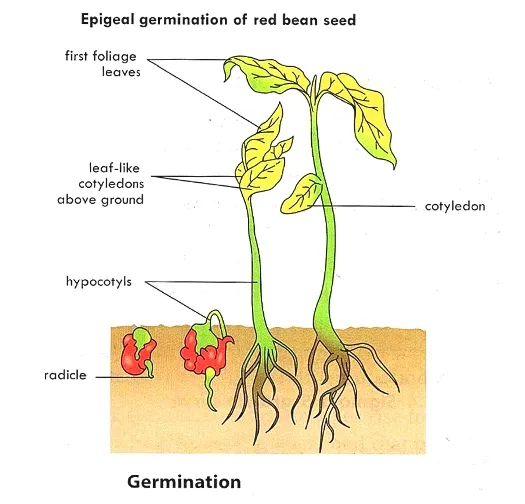
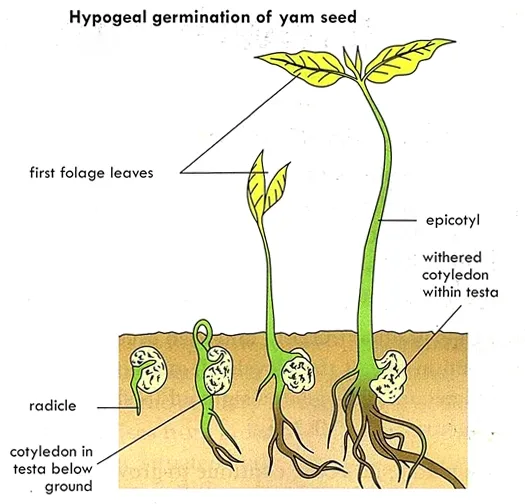 |
| Hypogeal germination of seed |
Significance of Germination
Plant Propagation: Germination is the first step in plant propagation, allowing plants to reproduce and spread.
Agricultural Productivity: Successful germination is crucial for crop production. Understanding germination can help improve agricultural practices and yields.
Ecological Balance: Germination contributes to the maintenance of plant populations and biodiversity in ecosystems.
Seedling Establishment: Germination ensures that the new plant can establish itself and grow independently, starting the life cycle anew.
- Discover the Importance of Germination on National Geographic.
Conclusion
Germination is a complex and vital process that marks the beginning of a seed’s transformation into a new plant. Understanding the stages, requirements, types, and significance of germination provides valuable insights into plant biology and ecology. This knowledge is essential for agriculture, horticulture, and conservation efforts, ensuring successful plant propagation and growth.
Key explanations and exam technique
From water uptake to growth
Imbibition hydrates tissues and permits metabolism to resume. Enzymes help mobilise stored reserves, while respiration supplies usable energy. Radicle emergence is a common operational criterion for germination. Later seedling growth includes root expansion, shoot emergence and the transition to photosynthetic nutrition. Do not equate every swollen seed with successful germination.
Requirements vary among species
Water, oxygen and a suitable temperature are normally necessary. Some seeds also require particular light conditions or dormancy-breaking cues. Flooding can reduce oxygen supply even when water is abundant. Soil is not always required for initial germination, because seeds contain reserves; later establishment requires an adequate mineral supply and a suitable environment.
Dormancy and quiescence
A viable dormant seed does not germinate despite otherwise favourable conditions. A quiescent seed may simply lack water or a suitable temperature. Different dormancy mechanisms require different treatments, and not every species benefits from the same treatment. In school work use known seeds and teacher-approved methods; do not improvise chemical or heat treatments.
Compare positions, not unrelated features
Epigeal and hypogeal describe whether the cotyledonary node is raised above or remains below the soil. Common bean and pea illustrate the contrast. Reserve location, testa or fruit-wall splitting, and presence of a coleoptile are separate characteristics. A coleoptile protects the young grass shoot; a coleorhiza surrounds the embryonic root region in grasses.
Make germination data comparable
Define the endpoint before collecting data, such as visible radicle emergence. Use equal numbers from a mixed seed lot, replicate treatments and count at consistent intervals. Report both final percentage and timing: two treatments may achieve the same final percentage but different speeds. Investigate mould, damaged seeds and counting mistakes rather than silently excluding them.
Compare the key concepts
| Feature | Germination | Seedling establishment |
|---|---|---|
| Main event | Embryo resumes growth; radicle emerges | Roots and shoot develop further |
| Energy initially | Stored reserves support respiration | Reserves plus increasing photosynthesis |
| Useful measure | Proportion reaching a defined germination endpoint | Survival, leaves, root and shoot growth |
| Key caution | Swelling alone does not prove viability | Early germination does not guarantee survival |
Worked calculation
Out of 50 seeds,38 show radicle emergence by day 7: germination =38/50 ×100 =76%. If 30 of those 38 establish as seedlings, establishment among germinated seeds =30/38 ×100 ≈78.9%; establishment among all seeds sown =30/50 ×100 =60%. State the denominator.
SHS multiple-choice practice
These are original practice questions, not an official examination paper. Select one answer for each.
1. A common operational sign of germination is
- Radicle emergence
- Flowering
- Fruit ripening
- Leaf fall
2. The initial uptake of water by a dry seed is
- Pollination
- Imbibition
- Translocation
- Abscission
3. A viable seed that fails to germinate under otherwise suitable conditions may be
- Necessarily dead
- Already mature wood
- Dormant
- Already a fruit
4. In epigeal emergence the cotyledonary node is
- Always underwater
- Absent
- Inside a flower
- Above the soil
5. Which pair is an appropriate example contrast?
- Common bean epigeal; pea hypogeal
- All dicots epigeal; all monocots hypogeal
- Every seed epigeal
- Only fruits hypogeal
6. Waterlogged seeds may fail because
- Water contains no molecules
- Oxygen availability is restricted
- Seeds never respire
- All seeds need dry soil
7. 42 of 60 seeds germinate. Percentage is
- 42%
- 60%
- 70%
- 140%
8. Which statement about stored reserves is accurate?
- Always starch in cotyledons
- Always in roots
- Always unnecessary
- Location and composition vary by species
Theory, critical thinking and extended investigations
DOK 1 — Recall and understanding
1. Define germination and identify a measurable endpoint. (3 marks)
2. Distinguish radicle, plumule and cotyledon. (3 marks)
3. Name three usual external conditions for germination. (3 marks)
DOK 2 — Application and explanation
4. Calculate germination when 54 of 72 seeds show radicle emergence. (3 marks)
5. Compare epigeal common-bean emergence with hypogeal pea emergence. (4 marks)
6. Explain how a seed can germinate on moist paper without soil. (4 marks)
DOK 3 — Strategic reasoning
7. Swollen seeds are counted as germinated. Evaluate the method and propose a better endpoint. (6 marks)
8. Two treatments reach 80% germination, but one takes 3 days and the other 10. Evaluate the claim that they are equally effective. (6 marks)
9. A learner concludes that all ungerminated seeds are dead. Develop alternative explanations and a testing sequence. (6 marks)
DOK 4 — Extended investigation
10. Follow replicated seed groups over two weeks under a teacher-approved single-factor comparison. Graph cumulative germination, analyse variation and redesign after anomalies. (12 marks)
11. Use supplied germination and establishment data to choose a seed lot for a fictional nursery. Reassess after price and later survival data are added. (12 marks)
12. Create a bean-versus-pea emergence record using repeated observations or image datasets. Label structures, test initial predictions and revise explanations using further stages. (12 marks)
Answers and marking guidance
Show MCQ answers and explanations
1. A — It marks embryo growth beyond the seed covering.
2. B — Water hydrates the seed tissues.
3. C — Dormancy is distinct from unsuitable external conditions.
4. D — Position defines the category.
5. A — Species-specific examples avoid false universal rules.
6. B — Aerobic respiration can be limited.
7. C — 42/60×100=70%.
8. D — Cotyledons/endosperm can store starch, oils or proteins.
Show theory answers and investigation guidance
1. Resumption of embryo growth; radicle emergence is a common criterion.
2. Embryonic root, embryonic shoot and seed leaf respectively.
3. Water, oxygen and suitable temperature; species-specific light requirements may also matter.
4. 54/72×100=75%.
5. Bean hypocotyl elongation raises cotyledonary node; pea cotyledons remain below while epicotyl raises shoot.
6. Water and oxygen supplied; stored reserves support initial metabolism; later mineral requirements remain.
7. Imbibition can occur without viable growth; define radicle emergence, consistent timing and replicates.
8. Final proportion same but timing differs; compare cumulative curves, establishment and intended use.
9. Dormancy, unsuitable conditions or insufficient time; verify conditions, use appropriate species information and validated viability assessment.
10. Defined endpoint, equal random allocation, water/oxygen controls, consistent counts, uncertainty and documented redesign.
11. Distinguish denominators, timing, viability and establishment; calculate usable seedlings/cost and revise choice.
12. Consistent labels and timing, cotyledonary-node position, distinction from reserve location, evidence-based revision.
Award marks for distinct correct points, clear reasoning and correct working up to the stated total. Accept scientifically sound alternatives. For each 12-mark DOK 4 task: question and design (2), evidence and method (3), analysis (3), evaluation and revision (2), communication (2). DOK describes cognitive demand rather than question length.
Sources and further study
Related posts
- Transpiration and Guttation
- Mineral Nutrients in Plants
- Dispersal of Fruits and Seeds
- Excretion in Plants
- Morphology Of Monocotyledonous and Dicotyledonous Plants
- Internal Structures of Plant Roots, Stems and Leaves
- Growth and Development of Plants
- Photosynthesis and Mineral Nutrition
- Gaseous Exchange in Plants
- Transport in Plants
- Reproduction in Plants
- WAEC/SSCE/ WASSCE/ NOVDEC Past Questions and Answers


4 responses to “Germination in Plants: The Birth of a New Plant”