Data Science Scholarships for International Students
A student finishes secondary school with strong mathematics results and hopes to study data science abroad. An online advertisement offers an impressive fully funded scholarship, but the detailed rules require a bachelor’s degree and two years of professional work. The award may be genuine, but it cannot help that particular applicant. Finding funding therefore begins with checking suitability rather than chasing the largest advertised sum.
International opportunities appear under computer science, mathematics, statistics, artificial intelligence, computational science and other related degrees. Universities, governments and research bodies sponsor awards at different academic stages. A program may cover tuition only, pay a regular allowance, support research, or require admission and nomination. One scholarship is not automatically accessible to every passport holder or every computing degree.
This updated guide explains verified undergraduate, master’s and doctoral pathways for 2027-focused applicants. It provides application checklists, a motivation-letter framework, practical portfolio suggestions, a fictional scholarship worksheet, and a worked study-abroad budget. It also explains why a scholarship offer must be confirmed before relying on it for financial planning.
Research reference date: November 15, 2026. Applications, eligibility and deadlines can change. Always reopen the official provider and university pages before submitting.
What Are International Data Science Scholarships?
An international scholarship supports eligible students undertaking study across borders under published rules. A relevant degree might be called data science, business analytics, applied mathematics, computer science, statistics or machine learning. The actual approved course matters, not simply its title.
A scholarship is education funding; a fellowship commonly supports advanced academic or research work; an assistantship may include teaching or research obligations. Need-based aid considers documented financial circumstances. Tuition waivers, living stipends and research grants are distinct forms of support. A research grant should not be treated as personal tuition money unless its conditions explicitly permit that use.
Before applying, confirm admission requirements, degree level, eligible nationalities, permitted program, timing and funding coverage. An international student may be eligible for university admission but ineligible for the scholarship attached to that course.
| Support | Meaning | Limitation |
|---|---|---|
| Full tuition | University fees | Living not necessarily covered |
| Comprehensive | Defined tuition + living and other support | Read exact contract |
| Partial | Specified percentage or amount | Budget residual costs |
| Stipend | Regular allowance | Duration and renewal matter |
| Research grant | Approved study costs | May not pay personal tuition |
Undergraduate, Master’s and PhD Funding Are Different
Undergraduate scholarships usually assess secondary-school achievements, admission readiness, references, leadership and sometimes financial need. Students preparing for their first university degree should not spend their time applying for doctoral research fellowships.
Master’s funding normally requires a recognized bachelor’s degree. Some scholarships require relevant work history, language proficiency or a specific full-time course. PhD awards emphasize original research, a suitable supervisor, a proposal, academic references and sometimes a university nomination.
In some countries outstanding bachelor’s graduates can enter a PhD directly; elsewhere a master’s qualification is customary. Doctoral packages may involve stipends, tuition support or employee duties rather than a conventional undergraduate scholarship. The appropriate stage is the first filter.
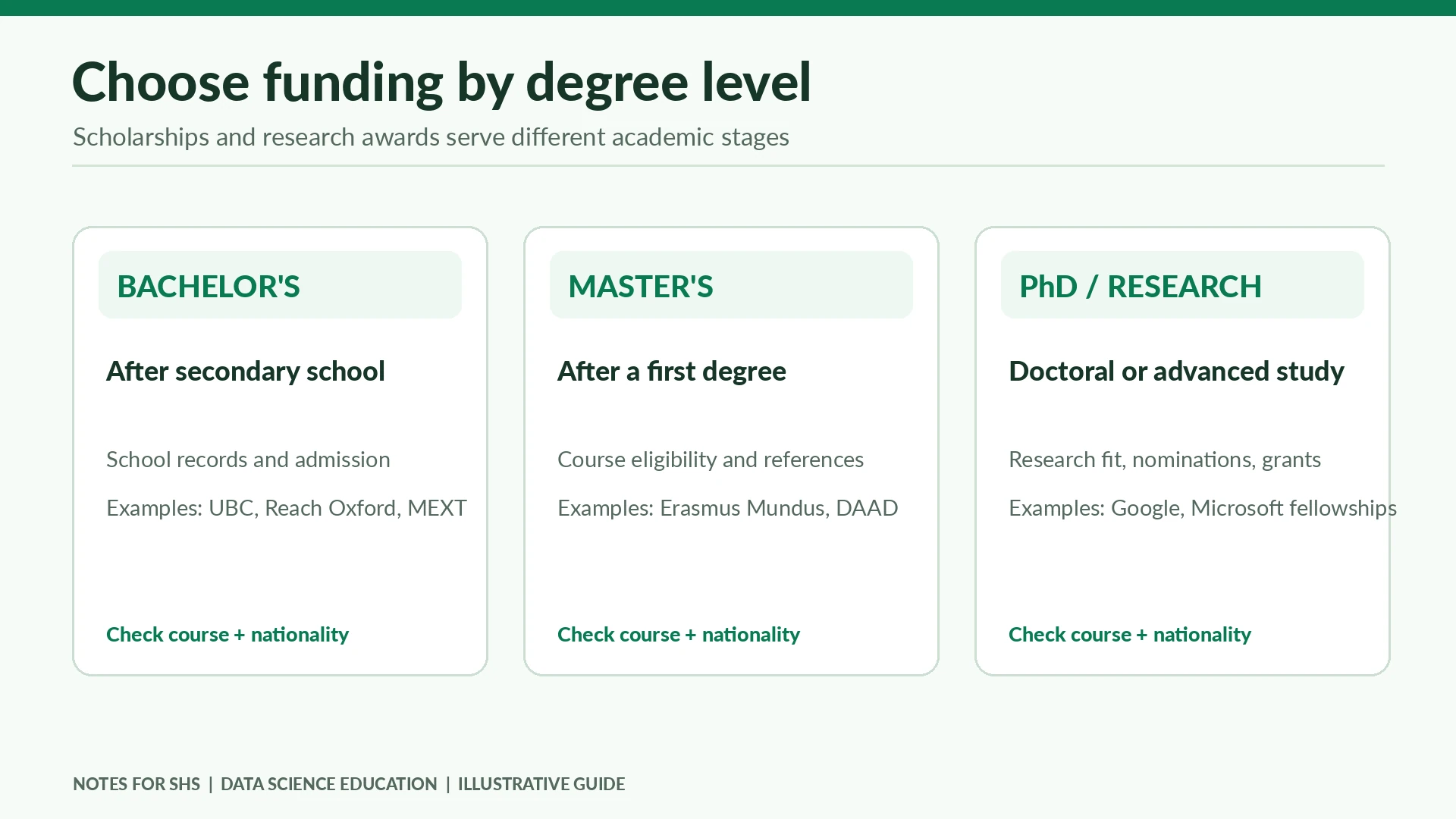
| Degree | Academic preparation | Examples |
|---|---|---|
| Bachelor’s | Secondary results, admission and recommendations | UBC, Reach Oxford, MEXT |
| Master’s | First degree, language evidence, sometimes work experience | Erasmus Mundus, DAAD, Chevening |
| PhD | Research proposal and possible university nomination | Google, Microsoft, Cambridge assistantships |
For earlier preparation see Data Science Scholarships for High School Students and the high school roadmap to a data science degree.
Verified Scholarship Opportunities and 2027 Application Status
The comparison below separates official programs by academic level, destination, eligibility and application status. A date listed for a scholarship is not necessarily the university admissions deadline. Each program requires checking the exact major and rules. This is not a ranking and does not imply universal availability.
| Verified award | Host | Level | Important restriction | Current status |
|---|---|---|---|---|
| UBC International Scholars | Canada | Bachelor’s | Need, admission, school nomination | Open: Dec 2, 2026 noon Pacific |
| Reach Oxford | UK | Bachelor’s | Specified countries + Oxford admission | Scholarship Jan 26; admission closed Oct 15 |
| MEXT embassy route | Japan | Bachelor’s | Nationality, approved major, exams | 2027 recruitment was spring 2026 |
| Türkiye Scholarships | Türkiye | Multiple levels | Approved degree and annual call | Annual Jan 10–Feb 20; verify 2027 |
| Stipendium Hungaricum | Hungary | Multiple levels | Sending country + partner nomination | 2027–28 deadline not confirmed |
| Mastercard Foundation Scholars | Partner universities | Bachelor’s or some master’s | Each partner’s criteria | Partner-specific |
| Erasmus Mundus | European consortia | Master’s | Selected joint master’s | Program-specific Oct–Jan |
| DAAD STEM | Germany | Master’s | Eligible country and tuition-free course | Country-specific; some closed |
| Chevening | UK | Master’s | Eligible country; post-degree experience | 2027–28 closed |
| Fulbright Foreign Student | US | Graduate | Participating country office | Country-specific |
| ADB–Japan | Designated institutions | Master’s | ADB nationality, experience, course | Institution-specific |
| Google PhD Fellowship | Research regions | PhD | University nomination | 2026 closed; 2027 unannounced |
| Microsoft Research Fellowship | Selected regions | Research fellows | Specific challenge eligibility | 2026 call closed |
| Gates Cambridge | UK | Postgraduate | Cambridge graduate course | Course-specific deadline |
Applicants should shortlist opportunities they actually qualify for instead of submitting to every prestigious institution. Where a future cycle has not been announced, an older deadline must not be reused or described as current.
Undergraduate Scholarships: Canada, Oxford, Japan and Other Routes
The University of British Columbia International Scholars Program supports eligible incoming international undergraduates with outstanding academics, substantial financial need and leadership or community contribution. Applicants need a school or qualifying organization nominator plus a separate teacher referee and must meet UBC admission and degree rules. Its extended 2027 deadline is December 2, 2026 at noon Pacific Time. The awards are not restricted to a specific data science degree.
The Reach Oxford Scholarship supports eligible students from specified countries with course fees, a living grant and a return flight each year, subject to its conditions. The scholarship deadline for 2027 entry is January 26, 2027, but Oxford’s general undergraduate admissions deadline for that intake was October 15, 2026. Missing university admission cannot normally be repaired by applying for the scholarship later.
Japan’s MEXT undergraduate embassy recommendation has nationality, academic and examination rules, and permitted majors must be checked. Embassy recruitment for 2027 arrival generally took place during April–May 2026, so that cycle is not newly open in November. Contact the correct Japanese embassy for a future round rather than sending documents directly to MEXT.
Türkiye Scholarships offers approved undergraduate, master’s and PhD courses with tuition and defined living and other benefits. Its published general annual calendar uses January 10 to February 20, but the precise 2027 call and course eligibility require fresh confirmation. Stipendium Hungaricum depends on sending-partner country nominations and approved programs; the reviewed page still displays 2026 dates, not a verified 2027–2028 deadline.
The Mastercard Foundation Scholars Program is administered by participating institutions, often with specific eligibility criteria for young Africans and different academic levels. There is no universal central application for every undergraduate computing course. Verify each partner’s degree offering, scholarship process and funding conditions.
Master’s Scholarships in Data Science and Related Fields
Erasmus Mundus Joint Masters brings students to participating institutions across several countries. Strong applicants worldwide may receive scholarships contributing to participation costs, travel, visas and living expenses. Apply directly to the selected master’s consortium; most programs have their own requirements and an application window around October–January, not one universal Erasmus data science deadline.
Germany’s DAAD Study Scholarships for STEM Disciplines supports eligible applicants from specified developing and emerging countries for qualifying full-time tuition-free STEM master’s degrees. The published 2027 award offers €992 monthly plus defined insurance and possible travel provisions. Data science courses must meet the program’s STEM conditions, and country-specific deadlines may already have passed.
Chevening supports eligible one-year master’s study in the United Kingdom. It requires a recognized undergraduate degree, qualifying citizenship and at least 2,800 hours of work experience accumulated after graduation over at least two years. The 2027–2028 application window is closed. This is not funding for fresh secondary-school graduates.
The Fulbright Foreign Student Program involves participating-country commissions or US embassies. Applications, eligible degrees, award coverage, deadlines and university placement arrangements vary by country. The ADB–Japan Scholarship Program supports approved master’s programs at designated institutions for eligible developing member-country citizens, normally including a bachelor’s degree and two years of post-degree professional experience. Neither is a global undergraduate data science award.
Mastercard Foundation partners may also offer master’s scholarships, but requirements differ from those at undergraduate institutions. Always check admission separately from the scholarship and verify whether the proposed degree is approved.
Doctoral Fellowships and University Research Funding
The Google PhD Fellowship supports exceptional computing-related research in eligible regions. Its 2026 application window is closed; a 2027 application date has not been announced. Eligible universities must nominate candidates. Students cannot independently apply, and award details and research fields differ across regions.
The Microsoft Research Fellowship now centers on particular research challenges. Some accept PhD researchers, others faculty or postdoctoral applicants, and funding or submission terms differ. The 2026 challenge call closed in November 2025. An old fixed stipend amount cannot accurately represent all opportunities.
Gates Cambridge supports eligible postgraduate study at Cambridge, not bachelor’s study. Selection assesses academic excellence, leadership and commitment to improving lives. Applicants must select a real qualifying course and observe its current funding deadline. Some 2027 entry deadlines vary by course, so verify the graduate directory rather than relying on an assumed universal date.
Research assistantships and departmental doctoral awards can also provide funding. Check whether the university offers tuition remission, a stipend, an employment contract or teaching duties. A potential supervisor’s research area must align with the applicant’s preparation; no funded position is guaranteed merely because a department lists data science research.
Scholarship Pathways by Region
Europe includes Erasmus Mundus, DAAD, Stipendium Hungaricum and university awards. The United Kingdom offers Reach Oxford, Chevening and Gates Cambridge at different levels. North America has UBC, country-specific Fulbright processes and doctoral assistantships. In Asia, MEXT and approved ADB–Japan master’s routes provide examples, while Türkiye has separate government scholarship programs.
Students interested in Africa can examine Mastercard Foundation partner institutions and relevant national programs. Institutional research awards also exist in the Middle East and Oceania, but each must be verified separately. A destination’s scholarship list does not establish nationality eligibility for every student.
| Region | Relevant routes | Important qualification |
|---|---|---|
| Europe | Erasmus Mundus, DAAD, Stipendium Hungaricum | Course and nationality restrictions |
| United Kingdom | Reach Oxford, Chevening, Gates Cambridge | Different degree levels and deadlines |
| North America | UBC, Fulbright, assistantships | Admissions and country participation |
| Asia / Pacific | MEXT, ADB–Japan | Embassy or approved institutional route |
| Türkiye | Government scholarship programs | Official course and annual call |
| Africa and partners | Mastercard Foundation and university awards | Individual partner conditions |

What Does Fully Funded Actually Mean?
A comprehensive package may pay defined tuition, living and other expenses, while a full-tuition scholarship might leave accommodation, transport, health insurance and visa costs uncovered. Partial assistance covers only some expenses. Stipends provide regular support subject to conditions; research assistantships may include paid work or academic obligations.
Review the award agreement, maximum duration, renewal requirements, exchange-rate risk, permitted expenses and payment timing. Even when an award is described as fully funded, applicants must confirm whether it covers every mandatory expense. Do not confuse admission, a fee waiver and a final funding commitment.

International Scholarship Eligibility Checklist
Before writing an application, confirm citizenship, residence, previous school location, academic level, recognized qualification, exact degree, university admission, grade threshold, work experience, language testing, standardized tests, research proposal, university nomination, financial need, deadline and time zone, start date, renewal conditions, post-study duties, required documents, official portal and rules about combining awards.
These are practical filters, not promises of selection. Record the answer for each scholarship in a private checklist and stop if a mandatory condition cannot be met. A genuine scholarship from an excellent university is still irrelevant if its degree level or country restrictions do not fit the reader.

Choosing a Data Science Degree That Qualifies
Review the actual curriculum: probability, statistics, programming, calculus, databases, data engineering, machine learning, ethics and research methods. A computer science degree with a data-science track may be suitable, but the funding program can restrict interdisciplinary courses or specific campuses.
Universities also differ in language standards and recognition of international qualifications. Consult the course catalog rather than assuming similar degree titles are interchangeable. Background work in mathematics for data science and research into career paths in data science can improve course selection.
Essential Scholarship Application Documents
Most applications require some combination of transcripts, graduation certificates, language evidence, identification, a curriculum vitae, academic recommendations, motivation letters, a portfolio, research statement and financial records when need-based assistance is involved. Graduate applications may also require supervisor support and university nomination.
Check whether translation, certification and submission through a specific portal are required. Ask references early and provide them with accurate achievements and the real closing date. Never upload confidential passports, family financial records or recommendation letters to unknown scholarship agents.
How to Write an Effective Motivation Letter
Begin with a genuine academic interest, support it with relevant mathematics, computing or research experience, describe one concrete achievement, and explain why the specific course fits your goals. Discuss a realistic contribution rather than offering generic praise for the university. Conclude with a concise explanation of fit between the applicant, curriculum and scholarship purpose.
For example, a fictional applicant might write: “When examining public rainfall records, I noticed that missing dates changed the interpretation of a trend. Documenting those gaps taught me to prioritize evidence and uncertainty. I now hope to study statistical computing to investigate environmental problems more responsibly.” This is instructional text, not a ready-made essay.
Avoid invented publications, copied statements, inflated leadership roles and AI-generated wording submitted contrary to scholarship rules. A truthful, distinctive account is stronger than exaggerated or interchangeable claims. See the research paper writing guide for supporting evidence.
Prepare a Credible Data Science Portfolio
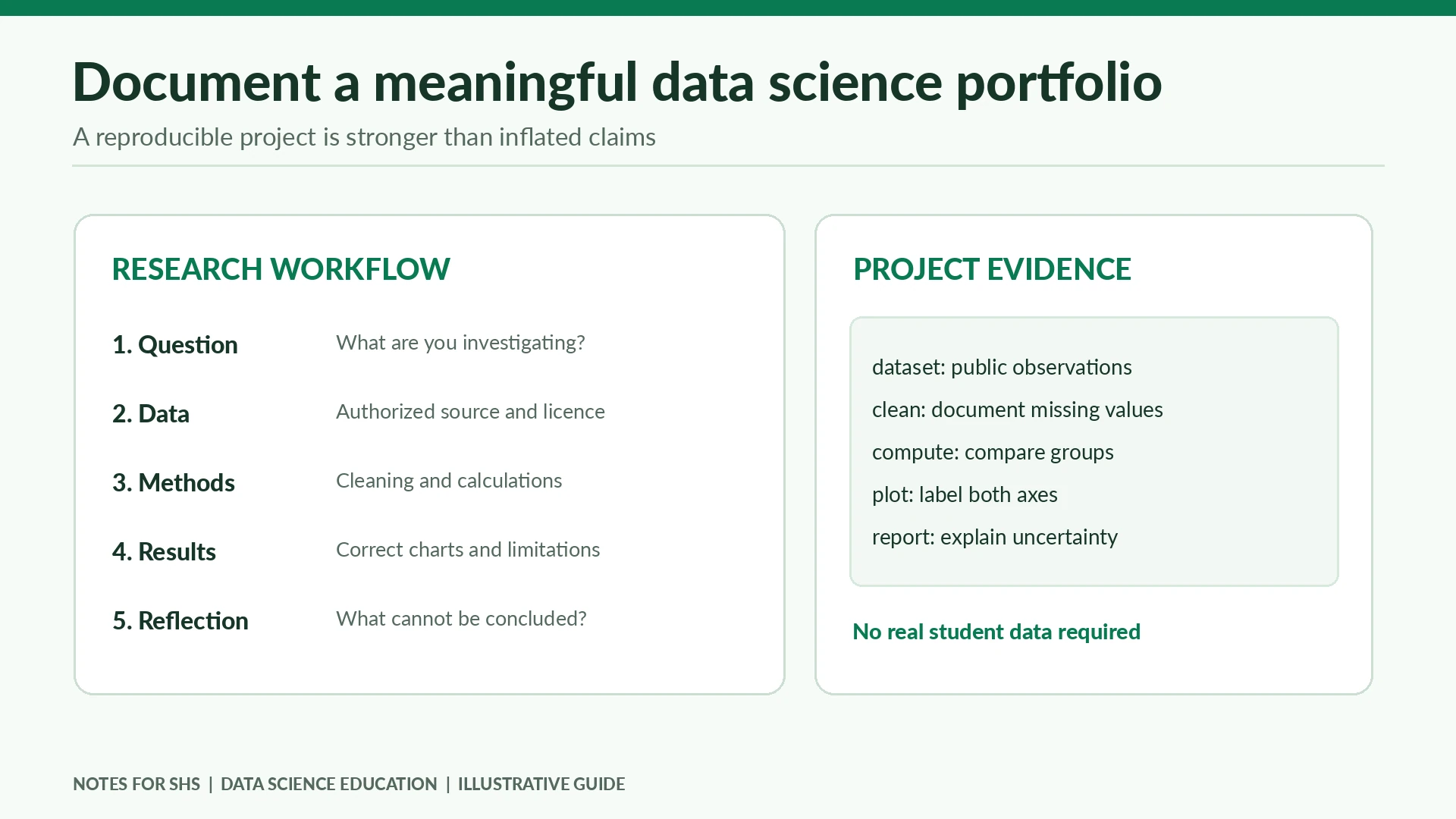
Useful portfolio evidence may include a short Python analysis, spreadsheet project, labeled visualization, open-dataset research, reproducible notebook or carefully evaluated machine-learning experiment. Each example should state the research question, data licensing, methods, results and limitations. Real student or client data should not be exposed.
Some awards emphasize leadership or financial need more than technical projects, so do not attach irrelevant files to every application. A small, well-explained study may be more useful than ten poorly documented certificates. See how to build a data science portfolio for examples.
Practical Exercise: Compare Fictional Scholarship Offers
The three opportunities below are completely invented for classroom use. The applicant is a fictional secondary-school graduate seeking a first bachelor’s degree. Global Computing Award covers all tuition but no living costs; Future Data Scholars Award covers half of tuition; and International Analytics Grant is for master’s applicants and is therefore ineligible.
| Fictional award | Degree | Tuition covered | Living support | Eligible? | Imaginary deadline |
|---|---|---|---|---|---|
| Global Computing Award | Bachelor’s | 100% | None | Yes | Jan 15, 2027 |
| International Analytics Grant | Master’s | 75% | Partial | No | Feb 10, 2027 |
| Future Data Scholars Award | Bachelor’s | 50% | None | Yes | Dec 20, 2026 |
The eligible fictional deadlines are December 20, 2026 and January 15, 2027, so the earlier one is Future Data Scholars Award. Global Computing offers the larger tuition share, but that alone does not establish affordability. Compare the whole budget before deciding. For real applications, replace these imaginary entries with official programs, course restrictions and current dates.
Worked Example: Calculate the Study-Abroad Funding Gap
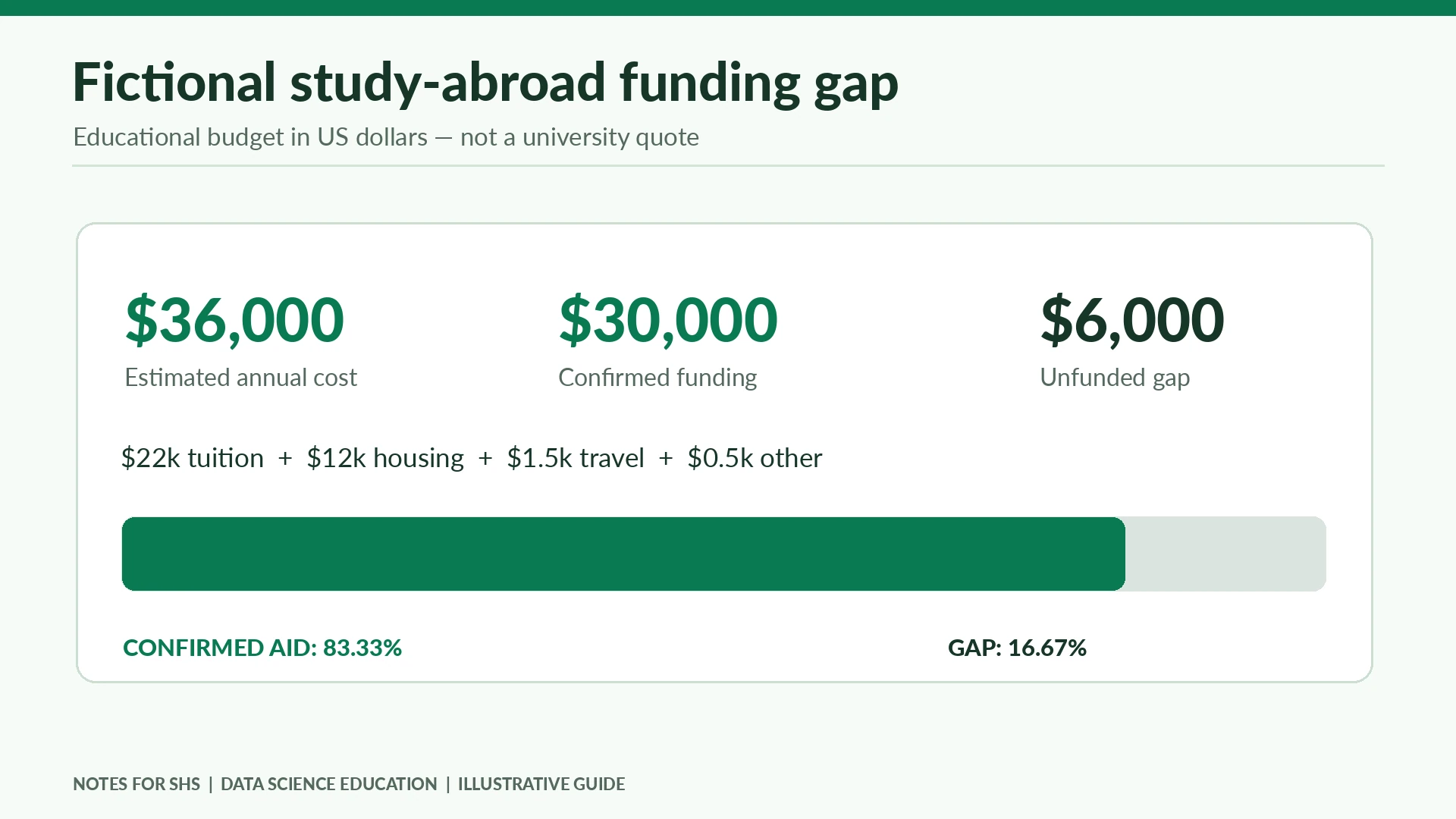
Consider a completely fictional annual budget in US dollars, not a price at any actual university. Tuition and fees are $22,000, housing and meals $12,000, travel $1,500, and insurance and other mandatory costs $500. The total is $36,000.
| Fictional annual budget | US dollars |
|---|---|
| Tuition and fees | $22,000 |
| Housing and meals | $12,000 |
| Travel | $1,500 |
| Insurance and other | $500 |
| Total | $36,000 |
Suppose a confirmed tuition scholarship covers $20,000 and an additional confirmed grant provides $10,000 usable for the remaining expenses. Total confirmed support is $30,000. The outstanding gap is $36,000 minus $30,000, giving $6,000, or 16.67% of the budget. Confirm both awards may be combined and that their use conditions match these assumptions.
Pending awards do not count as secured support. Real planning also requires checking visa costs, exchange rates, insurance rules, renewal conditions, deposits and unforeseen expenses. A tuition scholarship does not automatically settle living costs.
Eight-Week International Scholarship Application Plan
First select the correct degree level and official programs. Next check nationality, course eligibility and deadlines before collecting academic records. Draft original motivation and research statements, request references early, then review translations, funding terms and application instructions. Submit through the genuine portal and keep the confirmation privately.
| Week | Action | Result |
|---|---|---|
| 1 | Select degree and courses | Academic shortlist |
| 2 | Research official awards | Verified programs |
| 3 | Check eligibility | Nationality, level and dates |
| 4 | Gather documents | Transcript and portfolio |
| 5 | Write motivation | Program-specific draft |
| 6 | Request references | Nominators confirmed |
| 7 | Review submissions | Documents and deadlines checked |
| 8 | Apply and track | Official confirmation |

This schedule is an educational template. A looming deadline or complex research nomination may require more or less time, and applicants should not rush false or incomplete information to follow a generic plan.
Common Mistakes and Scholarship Scams
Typical errors include choosing the wrong academic level, assuming all STEM degrees qualify, ignoring citizenship restrictions, copying old dates, misunderstanding work requirements, presenting uncertain awards as guaranteed money, and neglecting admissions or reference deadlines. A simple program-by-program checklist helps prevent these problems.
Be wary of unsolicited winners, guaranteed awards for a processing payment, unofficial forms and recruiters asking for bank details. A legitimate university may charge an openly stated admissions fee; it does not mean an unknown agent can sell scholarship selection. Mastercard Foundation applicants should use the participating institution’s verified application route.
Continue Learning While Applying
Strengthen statistics, mathematical reasoning, Python, SQL and scientific writing through accessible resources. Practice with open data, explain a chart’s limitations and learn to present your own academic work clearly. A course may build useful foundational skills, but purchasing a certificate does not make a scholarship application eligible.
Students can consult subjects needed for data science and global demand for data scientists while planning their academic route. Verify practical skills without turning the article into a sales page.
Conclusion: Find Funding That Fits the Applicant
International scholarships are useful only when an applicant meets the degree, nationality, course, admission and funding conditions. Undergraduate programs assess school preparation; master’s opportunities normally require a first degree and may demand work experience; doctoral fellowships emphasize research, nominations and institutional fit. Treating all three as interchangeable wastes effort and can mislead readers.
Begin with official pages and exact deadlines. Confirm coverage before claiming that an award will finance study abroad, and count only funding already awarded in a budget. Prepare truthful essays, academic records, sensible projects and recommendations with enough time for review. Do not rely on third-party promises of guaranteed success.
Choose three real opportunities that match your nationality and academic stage. Record their official deadlines, approved courses and actual cost coverage, then complete the eligibility checklist and funding calculation before submitting.
Five Knowledge-Check Questions
- Is Reach Oxford for bachelor’s or doctoral study? Bachelor’s.
- Can a new school graduate normally apply to Chevening? No, it requires an undergraduate degree and experience.
- Does Google permit direct PhD fellowship applications? No, university nomination is required.
- Which fictional award is ineligible for the school graduate? International Analytics Grant (master’s).
- What remains after $36,000 costs and $30,000 confirmed funding? $6,000.
Frequently Asked Questions
1. Are fully funded data science scholarships available?
Some programs provide comprehensive funding, but each award defines eligible expenses, nationalities and courses.
2. Can a high school graduate study data science abroad?
Yes through eligible undergraduate degrees and scholarships, not master’s and doctoral research fellowships.
3. Which countries offer relevant scholarships?
Examples span Canada, the UK, European consortia, Germany, Japan, Türkiye and partner institutions; eligibility is program-specific.
4. Does Erasmus Mundus support data science master’s programs?
Eligible individual joint master’s consortia may award scholarships to students worldwide, subject to admission.
5. Who qualifies for DAAD STEM funding?
Applicants from selected countries with a qualifying first degree and an approved tuition-free German STEM master’s course.
6. How is master’s aid different from a PhD fellowship?
Master’s funding usually supports taught advanced study, while research fellowships often require original doctoral research and nominations.
7. What improves scholarship applications?
Accurate eligibility checks, verified deadlines, genuine academic evidence, tailored motivation and appropriate references.
8. How can students avoid scholarship fraud?
Use official provider portals, verify who handles decisions and avoid guaranteed-award payment demands.
Official Scholarship References
- UBC International Scholars — official program information
- Reach Oxford — official program information
- MEXT embassy route — official program information
- Türkiye Scholarships — official program information
- Stipendium Hungaricum — official program information
- Mastercard Foundation Scholars — official program information
- Erasmus Mundus — official program information
- DAAD STEM — official program information
- Chevening — official program information
- Fulbright Foreign Student — official program information
- ADB–Japan — official program information
- Google PhD Fellowship — official program information
- Microsoft Research Fellowship — official program information
- Gates Cambridge — official program information
Primary sources reviewed November 15, 2026. Applicants must confirm live deadlines and restrictions.



1 response to “Data Science Scholarships for International Students”