Subjects Needed in High School to Become a Data Scientist
A high school student who enjoys mathematics and technology must choose between physics, economics and a computing elective. They want to become a data scientist but cannot take every advanced subject. Should they prioritize calculus, programming, science or something else? What if their school does not offer statistics?
Data science is multidisciplinary. Mathematical reasoning is important, statistics helps evaluate evidence, computing helps process information and communication turns results into useful explanations. Biology, physics, economics and geography can provide valuable subject knowledge. Yet useful preparation and formal university entry conditions are different questions.
This internationally focused guide explains subject priorities, compares AP, A-level, IB and national senior school qualifications, and examines three official 2027 university examples. It includes a downloadable fictional readiness planner, spreadsheet charts and a small library-data activity. No combination of subjects can guarantee a university offer or a data science job.
What you’ll learn: Core subjects, complementary electives, required versus preferred qualifications, university admissions, accessible learning alternatives and practical planning.
What Does a Data Scientist Do?
Data scientists examine research questions by preparing data, calculating statistics, building and evaluating models, visualizing patterns and explaining limitations. Data analysts often focus on preparing and reporting information. Statisticians emphasize inference and research design, while machine learning engineers frequently develop model-based software systems. These descriptions are broad and can overlap.
Even students without coding experience can start with a fictional dataset and well-labeled chart. Learn the general process in Introduction to Data Science. Professional job titles and entry requirements vary; no one degree or school subject guarantees a particular career.
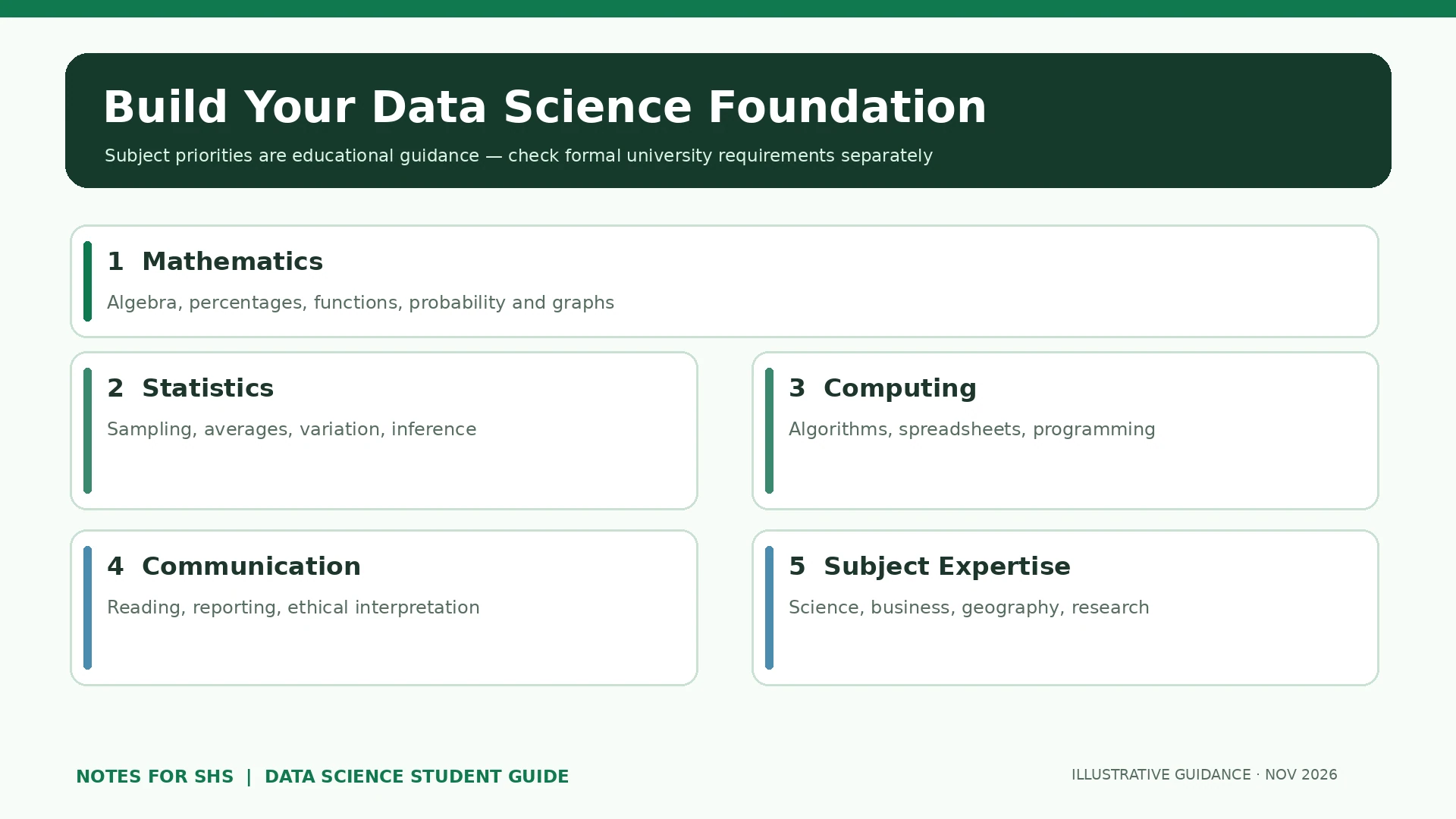
Mathematics: The Central Academic Priority
Mathematics is often the most important subject to protect in a university preparation plan. Algebra, functions, percentages, graphs and mathematical reasoning help students understand patterns. Probability and advanced algebra add depth; calculus, linear algebra and optimization become useful for many sophisticated statistical and machine learning methods.
Introductory statistics and spreadsheets do not require advanced calculus, but several selective quantitative degrees require high-level mathematics qualifications. Do not drop a course before checking entry conditions. Further Mathematics can be valuable when available. For worked examples, see The Importance of Math in Data Science.
Statistics and Probability
Statistical reasoning involves data collection, sampling, averages, variation, probability, regression and uncertainty. It helps explain why a difference between two groups may not establish cause and effect. The American Statistical Association’s GAISE II guidance emphasizes evidence-based statistical education rather than mechanical calculations alone.
Statistics may appear as a standalone course, as AP Statistics or within the mathematics curriculum. A separate high school Statistics certificate is not universally required. Students whose schools lack this elective can work through the authorized free Advanced High School Statistics fourth edition and supervised projects.
Computer Science, ICT and Programming
Computer science develops algorithms and computation. ICT can emphasize practical digital skills, depending on the approved syllabus. Programming uses variables, loops, conditionals, functions and data structures to process information. Python, R and SQL are common choices later; students can also begin by using basic spreadsheet formulas.
Importantly, AP Computer Science A teaches Java, not Python. Its problem-solving skills transfer, but learning Python separately may help. Prior high school computer science is not compulsory for every university data science degree. Students without it can follow Learning Python for Data Science in High School and learn gradually.
English and Communication Skills
Data scientists write reports, read technical materials, describe research questions, present charts and communicate uncertainty to specialists and nonspecialists. English or another school language of instruction can develop these abilities. International university applicants must separately verify any formal academic-language requirements.
Practice by writing four sentences about an invented chart: what was counted, what the result shows, which limitations matter and what the data cannot establish. Clear reporting is part of responsible analysis, not merely a decorative soft skill.
Physics and Scientific Reasoning
Physics provides experience in measurement, units, experiments, graphs, error estimation and numerical models. Such skills can support scientific computing, robotics, engineering analytics, transportation systems and sensors. A fictional investigation of temperature measurements can develop useful habits without expensive equipment.
Physics is not a universally required subject for all data science degrees. Its priority depends on the exact program and intended specialization. Mathematics or another mandated subject should not be replaced based only on a general career recommendation.
Biology, Chemistry and Environmental Science
Biology can introduce genetics, ecosystems, health research and population measurements. Chemistry contributes laboratory measurements, material analysis and quality control. Environmental science covers weather, land use, pollution and conservation observations. These subjects offer context for specialized data science problems.
A student interested in healthcare analytics may benefit from biology, while environmental data science may draw more on geographic or scientific measurements. They are valuable elective choices, not a requirement to study all three. Ethics matters when records concern patients, people or sensitive species locations.
Economics, Business Studies and Accounting
Economics examines markets, incentives and statistical trends. Business studies explores operations, consumer research and resource planning, while accounting emphasizes structured records and numerical accuracy. Each can motivate projects involving retail, finance or organizational decisions.
These subjects complement mathematics rather than automatically substitute for it. If a particular degree lists an advanced mathematics prerequisite, an excellent business grade cannot be presumed equivalent. Use fictional financial or inventory information for introductory exercises instead of private records.
Geography and Social Sciences
Geography introduces maps, geographic information systems, population statistics and environmental patterns. Sociology, psychology and related subjects develop survey reasoning and the interpretation of human behavior. Such knowledge can help with social or geospatial applications of data analysis.
Survey findings require careful sampling, privacy safeguards and restraint when interpreting group differences. These subjects can be strong optional electives depending on personal interests. They are not universal conditions for data science university entry.
Technology Electives and Extracurricular Activities
Additional Mathematics, Further Mathematics, Statistics, Programming, Computer Science, Robotics, Research Methods, ICT and Data Science may be useful school options. The exact content matters more than fashionable titles. Coding clubs, math teams and science fairs can develop teamwork, verification and communication.
Do not overload your schedule with extracurricular certificates merely to appear qualified. One clear project with reproducible results is valuable. For structured topic ideas, explore the High School Data Science Curriculum.
Which Subjects Are Required, Preferred or Optional?
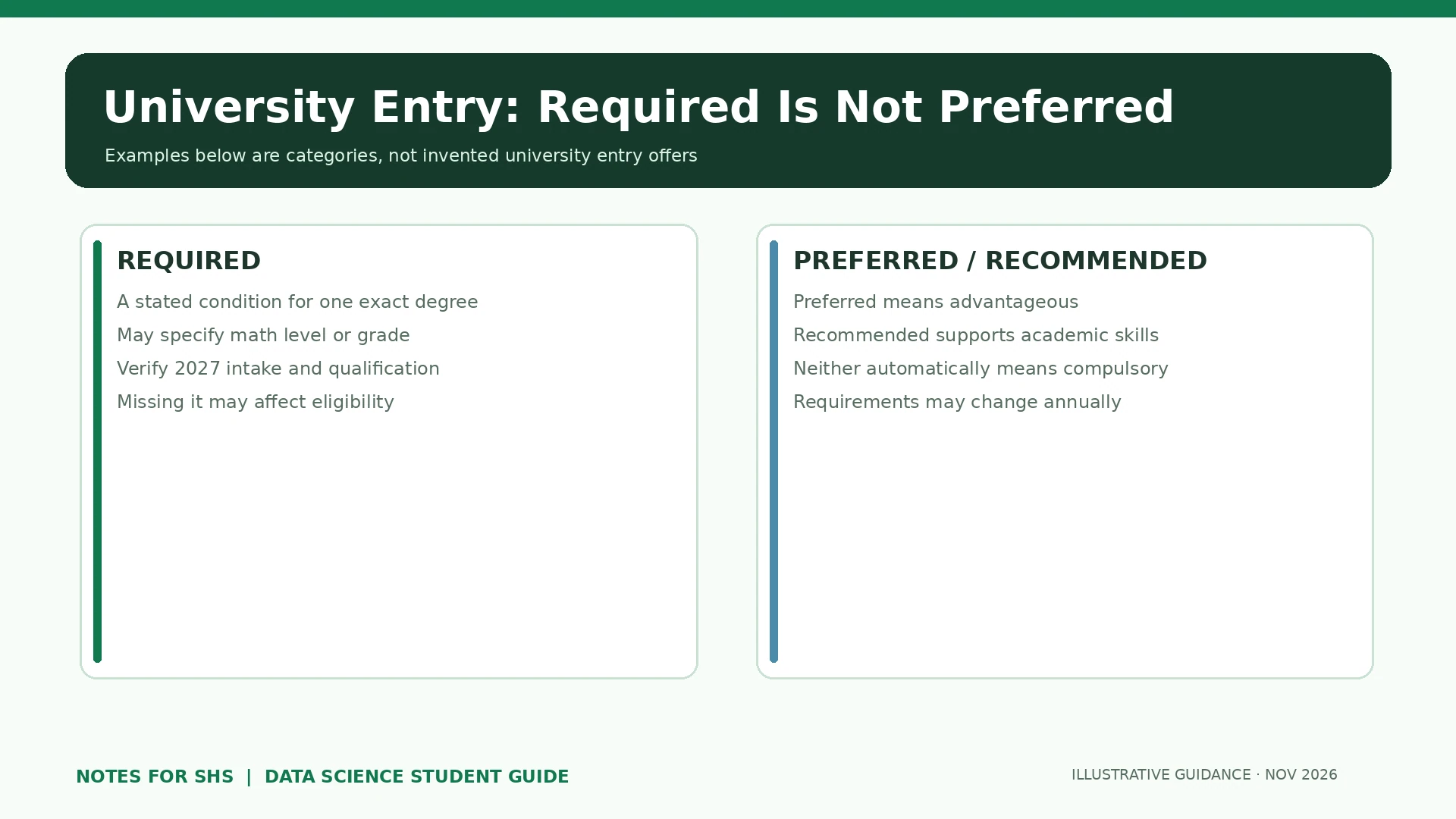
A required subject is a stated admission condition for a named course, qualification and entry year. Preferred may indicate an advantage or a specific offer route. Recommended describes educationally useful preparation without necessarily becoming an eligibility condition. These distinctions are essential when comparing universities.
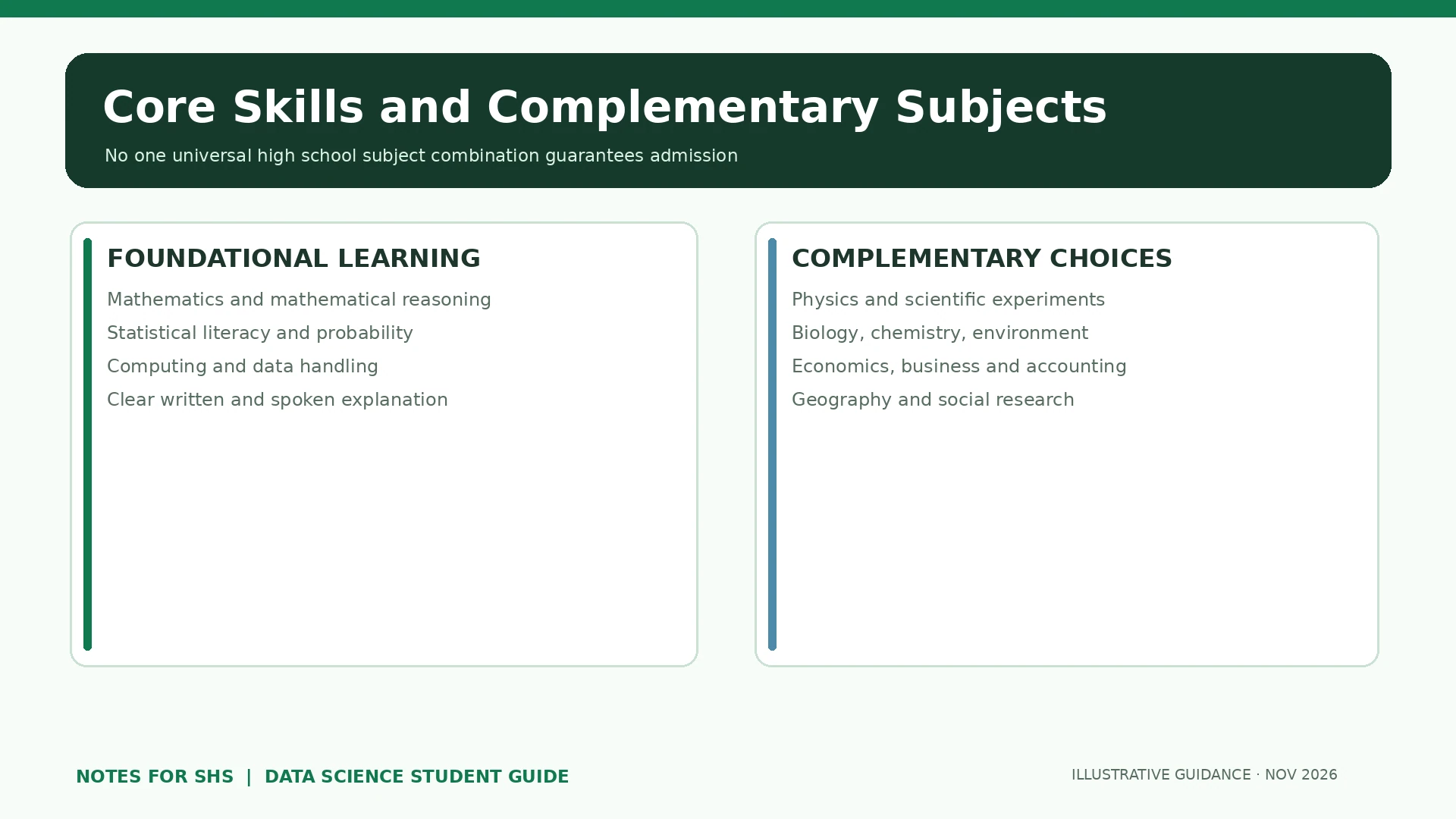
| Subject | Preparation priority | Typical value | Universally required? |
|---|---|---|---|
| Mathematics | Highest | Algebra and quantitative reasoning | No identical global rule; often specified |
| Statistics / Probability | High | Sampling and uncertainty | Not always a separate qualification |
| Computer Science / ICT | High | Algorithms and data handling | No |
| Writing / Communication | High | Reports and explanations | Language requirements vary |
| Further Mathematics | Program-specific | Advanced quantitative study | Only some routes |
| Physics, Biology, Chemistry | Interest-based | Scientific applications | No |
| Economics, Business, Geography | Interest-based | Domain analysis | No |
International Pathways: AP, A-Levels, IB and National Qualifications
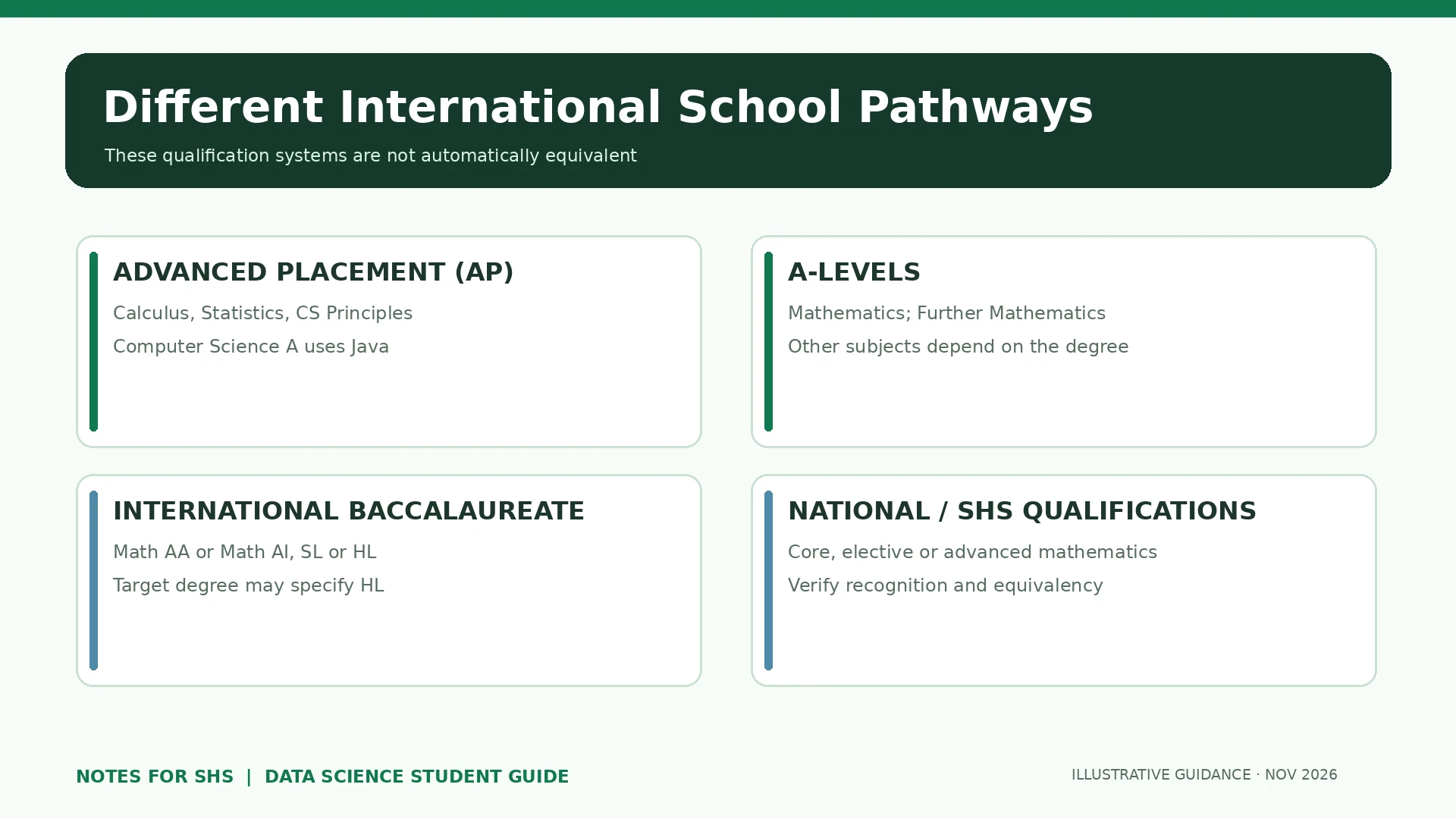
AP offers individual subjects such as Calculus AB or BC, Statistics, Computer Science Principles and Computer Science A. Their availability and university use differ. Computer Science Principles is a broad introduction; Computer Science A emphasizes Java programming. An AP exam is not automatically accepted for credit or entry everywhere.
A-level students considering mathematics-heavy degrees often prioritize Mathematics and may choose Further Mathematics, Computer Science, Physics, Statistics or Economics. Published universities distinguish requirements, typical offers, contextual offers and any additional mathematics assessment. Never assume every UK degree demands the same subjects or grades.
The IB offers Mathematics: Analysis and Approaches and Mathematics: Applications and Interpretation at Standard and Higher Level. Some degrees accept both at Higher Level; others specify routes. Consult the IB’s official mathematics information and the precise university course requirements instead of treating AA and AI as interchangeable worldwide.
National or senior high school systems may include Core, Elective, Additional or Further Mathematics, English, ICT, Economics and sciences. National examinations such as WASSCE have country-specific qualification rules. Technical or vocational routes may also be recognized, but equivalencies must be checked with the admissions institution.
| School qualification | Potential preparation | Important condition |
|---|---|---|
| AP | Calculus, Statistics, CS Principles, CS A | Not available in every school; CSA uses Java |
| A-levels | Math and possibly Further Math | University-specific offer routes |
| IB Diploma | Math AA or AI, SL or HL | Exact level and grades may be specified |
| National senior secondary | Recognized math, language, computing and sciences | Equivalency depends on institution |
| Technical or vocational | Quantitative skills and practical IT | Acceptance is program-specific |
Official University Admissions Examples — 2027
The following information was reviewed on November 18, 2026. It applies to the named courses and qualifications for 2027 entry, not to every department at those universities. Admission policies may change; applicants must check their current official requirements and their own qualification equivalencies.
UCL Data Science BSc (UK): the 2027 standard A-level offer is A*AA, with A* in Mathematics required and Further Mathematics preferred. The standard IB offer is 39 points, including Higher Level Mathematics grade 7; UCL lists Mathematics AA or AI at HL. Other qualification and contextual routes differ.
Warwick Data Science BSc (UK): 2027 A-level offers vary depending on Further Mathematics and, for some routes, STEP, TMUA or AEA. Warwick lists IB routes including 39 points with HL Mathematics grade 7, or 38 points with HL Mathematics grade 6 plus a qualifying additional assessment. Check each precise alternative.
Waterloo Data Science (Canada): for Ontario applicants, required subjects include Advanced Functions, Calculus and Vectors, and a Grade 12 U English course. The Admission Information Form is required, while Grade 11 Computer Science is recommended. Waterloo’s counselor guidance confirms direct application to the Data Science major for September 2027.
| University / program | 2027 & qualification | Mathematics and other conditions | Official source |
|---|---|---|---|
| UCL — Data Science BSc (UK) | 2027 / A-level or IB | A*AA with A* Math; IB 39 and HL Math 7 (AA or AI). Further Math preferred. | UCL 2027 |
| Warwick — Data Science BSc (UK) | 2027 / A-level or IB | Math central; Further Math and STEP/TMUA/AEA alternatives. IB HL Math requirements vary by route. | Warwick 2027 |
| Waterloo — Data Science major, BMath/BCS (Canada) | Sep 2027 / Ontario | Advanced Functions, Calculus and Vectors, Grade 12 U English, AIF. | Waterloo program |
Important: Eligibility is not guaranteed admission. Verify required and preferred subjects, expected grades, tests, contextual offers, language proficiency and international qualification equivalency with the admissions team.
Can I Study Data Science Without Computer Science, Physics or Calculus?
Yes, previous school computer science and physics are not universally required for every data science degree. However, some programs expect substantial quantitative preparation and specific combinations. Students without coding subjects can learn spreadsheet formulas, variables, loops, functions and data visualization from introductory resources.
Calculus is not required for beginner data analysis, but some degrees explicitly require advanced mathematics. If Further Mathematics is unavailable, ask whether the institution accepts another recognized qualification or an alternative assessment. Independent courses help understanding but cannot automatically replace a mandatory formal subject. See how to get started with data science.
Data Science and Related University Degrees
A Bachelor’s degree in Data Science combines mathematics, computing and data applications. Statistics offers deeper inference and research design; Mathematics and Applied Mathematics offer quantitative depth; Computer Science emphasizes algorithms and software; related quantitative or interdisciplinary degrees can also provide foundations.
Career paths differ and may require additional education or experience. The US Bureau of Labor Statistics describes the United States occupational context, not a universal career rule. The high school roadmap to a data science degree explains broader preparation without promising an employment outcome.
| Degree route | Main strength | Important caveat |
|---|---|---|
| Data Science | Integrated statistical and computational study | Prerequisites differ |
| Statistics | Inference, probability and research | Quantitative foundation essential |
| Mathematics / Applied Math | Advanced mathematical models | May require stronger math |
| Computer Science | Computing systems and algorithms | Math and coding expectations vary |
| Other quantitative degrees | Science or domain expertise | Further training may be needed |
Student Activity: Build a Fictional Subject Readiness Dashboard
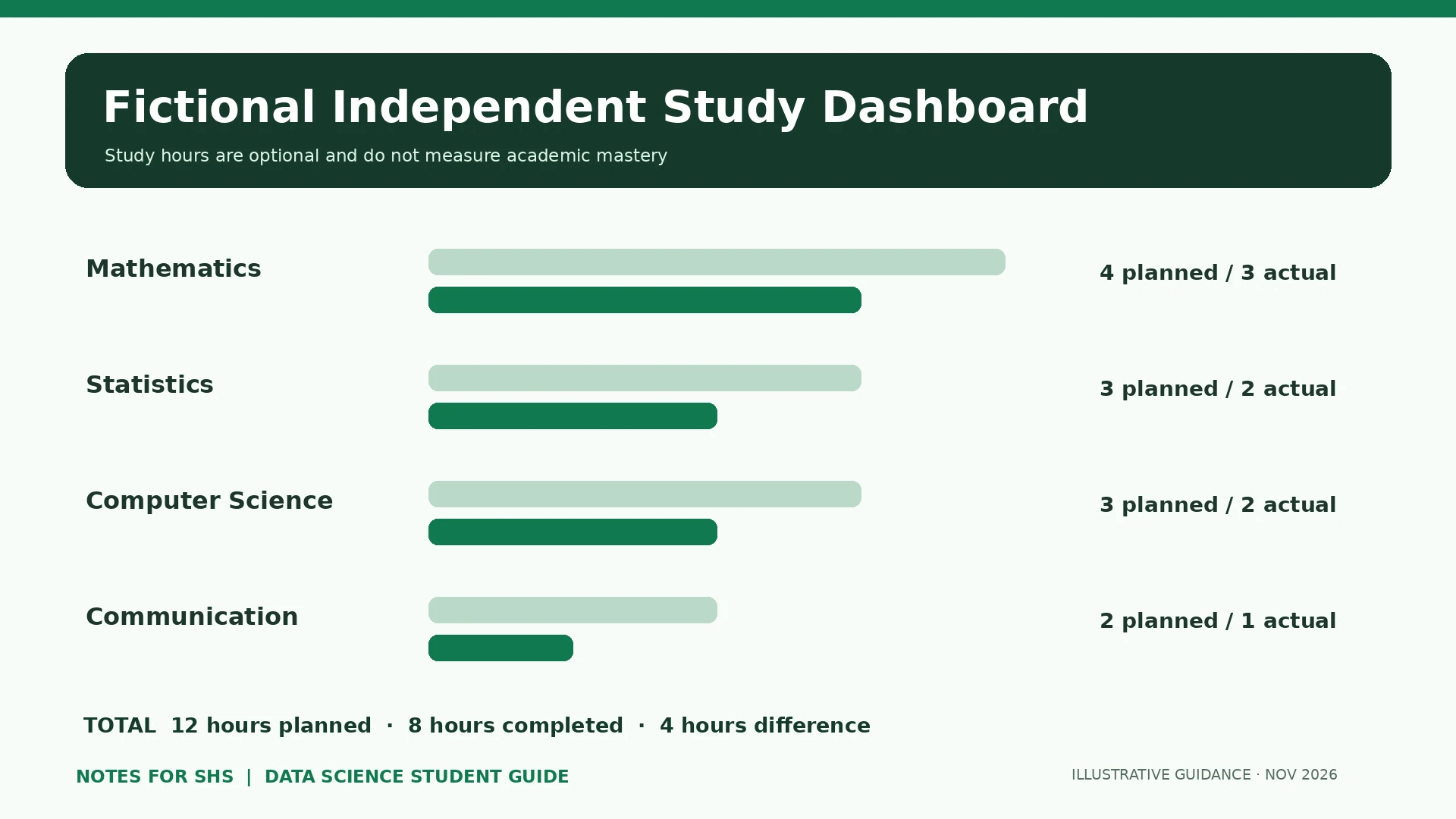
Consider an invented student’s optional independent learning plan, separate from required school lessons. Mathematics is allocated four hours weekly, Statistics three, Programming three and Communication two. The student actually completes three, two, two and one respectively. These figures illustrate planning, not a universal study timetable or an academic ability test.
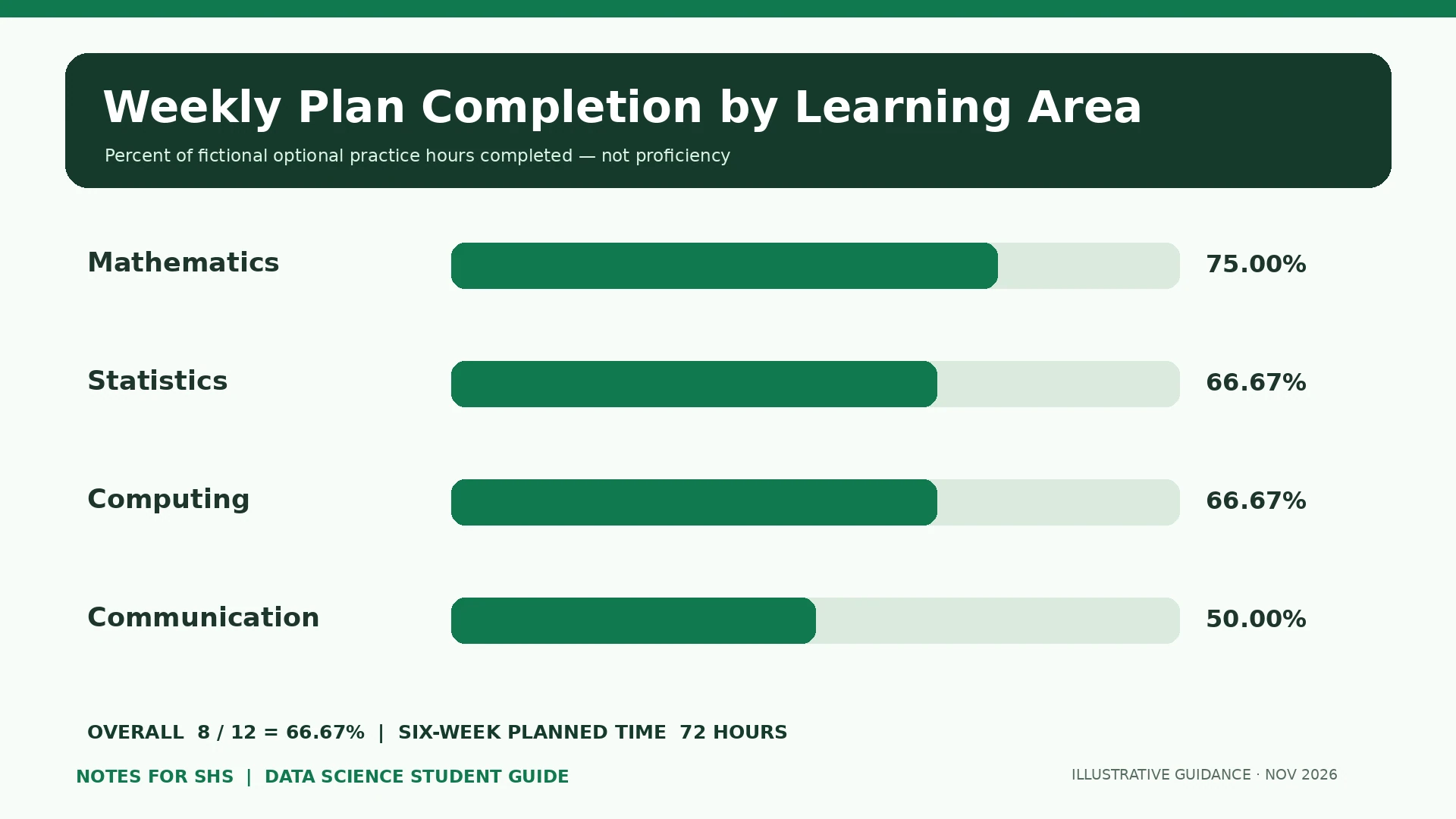
Planned total = 4+3+3+2=12 hours; completed = 3+2+2+1=8 hours. The four-hour difference shows incomplete planned time, not failure. Mathematics completion = 75%, Statistics and Programming each ≈ 66.67%, and Communication = 50%.
Overall completion = 8÷12 × 100 ≈ 66.67%. If the same planned schedule continues for six weeks, Mathematics totals 24, Statistics 18, Programming 18 and Communication 12, giving 72 planned hours. These are scheduling projections, not mastery scores or university credits.
| Fictional area | Planned | Actual | Difference | Completion | 6-week plan |
|---|---|---|---|---|---|
| Mathematics | 4 | 3 | 1 | 75% | 24 |
| Statistics | 3 | 2 | 1 | 66.67% | 18 |
| Programming | 3 | 2 | 1 | 66.67% | 18 |
| Communication | 2 | 1 | 1 | 50% | 12 |
| Total | 12 | 8 | 4 | 66.67% | 72 |
Excel or Google Sheets: Reproduce the Readiness Plan
Create columns A through F for Learning Area, Planned Hours, Actual Hours, Difference, Plan Completion and Six-Week Plan. Enter the four areas in rows 2–5 and use row 6 for totals. In D2 type =B2-C2, in E2 =IF(B2=0,"",C2/B2), and in F2 =B2*6.
Copy formulas through row 5. Use SUM for planned, actual, difference and six-week columns in row 6. Overall E6 is =C6/B6, formatted as a percentage. Make separate charts for planned versus actual hours, completion and six-week planned hours. None assesses learning quality.
Download the Notes for SHS subject-readiness and university checklist Excel workbook. It contains recalculating formulas, three charts, a six-week plan, a fictional library exercise, official university source links and space for study reflections.
Mini Cross-Subject Project: Fictional Library Visits
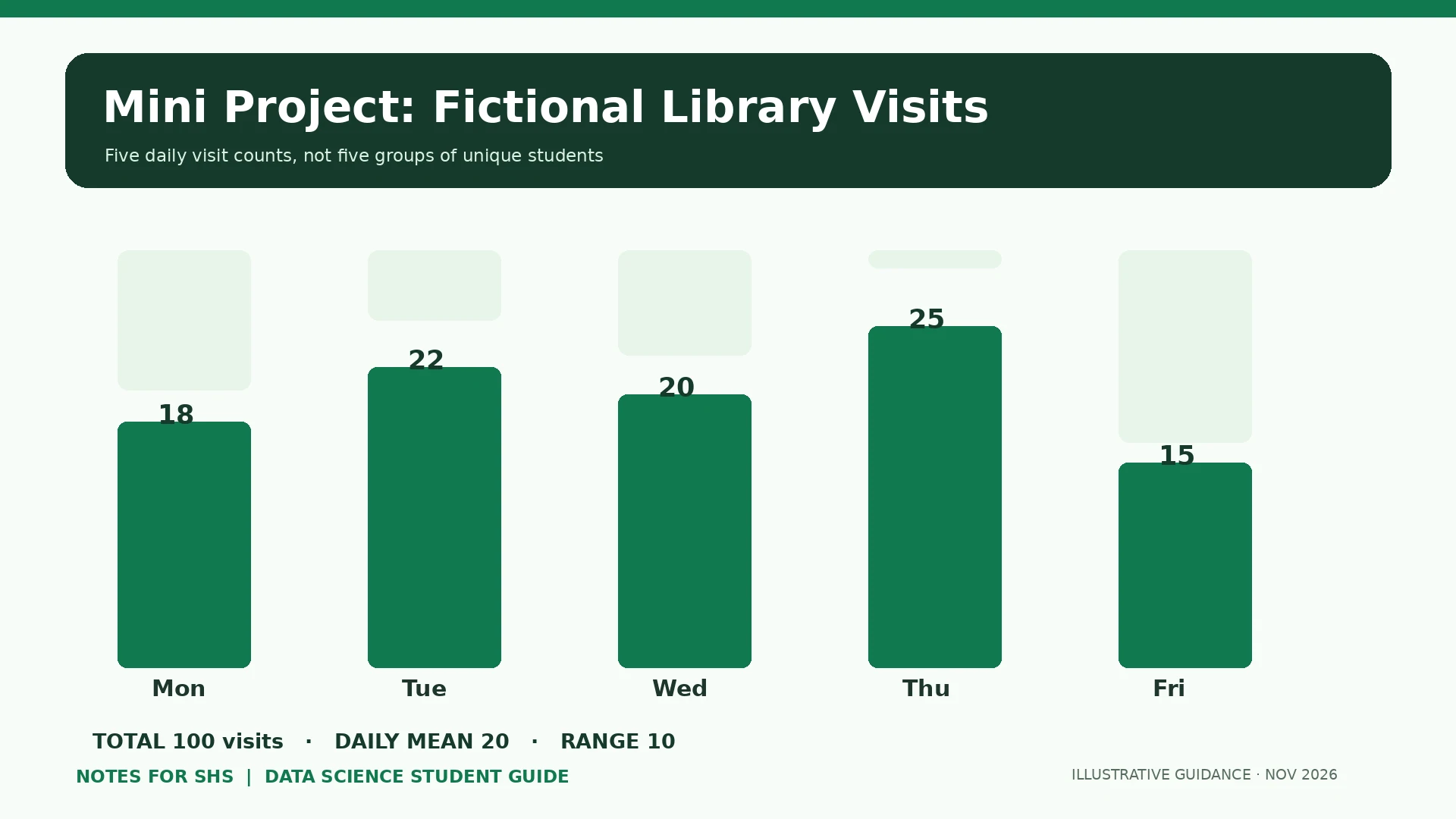
A fictional school library records visits of 18, 22, 20, 25 and 15 across Monday to Friday. Mathematics gives a total of 100 visits, an average of 20 visits per day and a range of 25−15=10. Visits need not mean 100 distinct people.
Statistics describes day-to-day variation, computing creates a bar chart, writing explains the findings, and social science suggests hypotheses to investigate. These five observations cannot establish why demand varied. Use no identifiable student records or private borrowing histories.
Choosing Subjects When Your School Has Limited Options
If Statistics is unavailable, use mathematics and free exercises. If Computer Science is absent, learn spreadsheets or introductory programming gradually. Without school computers, printed tables and a calculator are useful. With limited internet, seek legitimate library texts and offline practice rather than assuming paid software is necessary.
Where an exact degree requires Further Mathematics or an equivalent, self-study does not automatically satisfy its admission rule. Ask the institution about recognized alternatives, foundation routes or related degrees. Do not abandon compulsory graduation subjects or overload your timetable with unmanageable extras.
Example Subject Combinations by Interest
Possible academic combinations include Mathematics plus Further Mathematics and a science for advanced quantitative study; Mathematics, Computer Science and an elective for computing; Mathematics and Biology for health analysis; Mathematics and Geography for environmental data; or Mathematics and Economics for business analytics.
These are illustrative preparation routes, never universal admissions prescriptions. Schools have different timetables and national examinations. Check your selected degree, school graduation requirements, academic strengths and any officially required language and mathematics courses.
University Entry Checklist and Free Learning Resources
For two or three target degrees, write down the exact university, program title, entry year, accepted qualification, mandatory and preferred subjects, minimum grades, math level, language requirements, tests, deadlines and international equivalencies. Record the date checked and ask the university about ambiguous requirements. Eligibility alone is not an offer.
Free learning resources include Khan Academy mathematics, OpenIntro Advanced High School Statistics, fourth edition (2026), official AP Statistics guidance, IB Mathematics and the Python tutorial for readers with basic programming knowledge. A course completion does not replace formal admissions qualifications.
Four-Stage Academic Preparation Roadmap
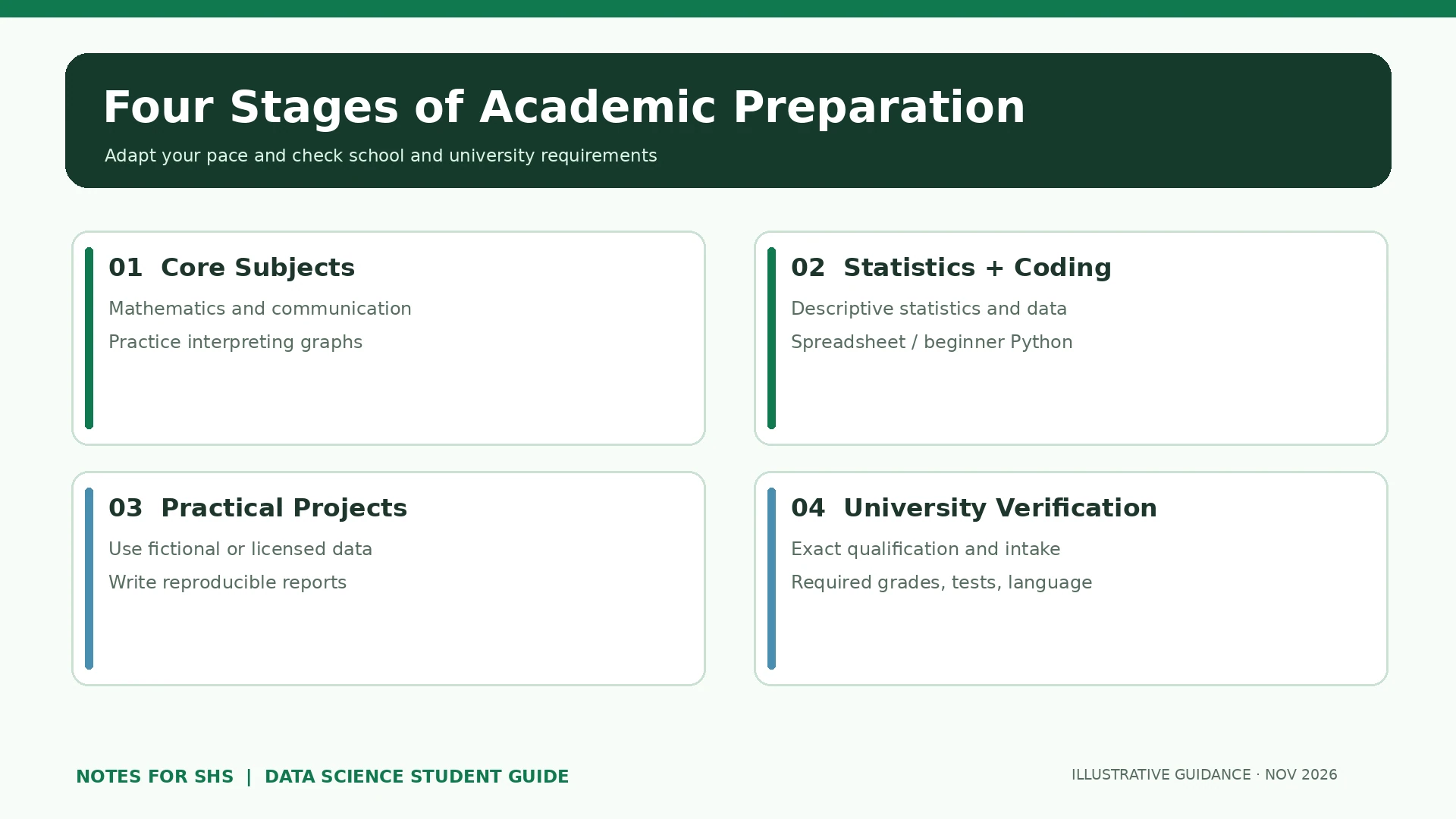
Stage one strengthens school mathematics and writing. Stage two adds statistics, spreadsheets and coding. Stage three applies these skills to an original safe project. Stage four verifies university subject requirements and adjusts choices before application deadlines. The stages can overlap; they do not define one worldwide graduation timeline.
The study hours are optional, and progress should be evaluated through worked exercises, feedback and clear explanations rather than time alone. A careful project with a documented limitation is more educational than a long list of untested certificates.
Common Subject-Selection Mistakes
Do not choose fashionable technology subjects while ignoring mandatory mathematics. Avoid assuming every university requires physics or previous coding, confusing Java-based AP Computer Science A with Python, treating all IB levels as equivalent or reading an outdated admissions blog as official guidance.
Online certificates, competition entries and self-study can demonstrate interest but do not guarantee admission. If one option is inaccessible, investigate other legitimate degrees and qualification routes with a counselor instead of assuming every future study path is closed.
Academic subject names are not enough to judge preparation. An ICT course in one system may cover practical office software, while a Computer Science course elsewhere emphasizes programming and algorithms. Look at the official syllabus and the exercises students actually complete before treating their content as equivalent.
Keep the distinction between qualifications and personal skills clear. A learner may write strong Python programs independently yet still be ineligible for a particular degree without a published Mathematics qualification. University admissions teams decide whether alternative recognized routes satisfy such rules.
Statistics can be learned effectively within several school subjects. Geography students may summarize population data, biology students may compare experimental results, and economics students may work with trends. Always record which sample was studied and whether its findings can be generalized.
A fictional plan showing 66.67 percent completion is not a moral judgment or a reliable admissions readiness index. Students have different responsibilities, access to equipment and study needs. Revising the plan to protect adequate rest and effective learning is more productive than chasing hours alone.
Verify the entry year each time you compare institutions. University pages sometimes carry saved versions or updated assessment arrangements, and requirements for international qualifications can be held on a separate page. Keeping the source URL and verification date prevents avoidable confusion.
Conclusion: Choose Subjects, Then Verify the Requirements
Mathematics is a strong foundation for data science, while statistics, computing and communication develop the ability to examine evidence and explain results. Science, business and social electives add specialist knowledge. The best subject combination depends on the student’s qualification, available school courses, mathematical preparation and intended academic program.
The 2027 examples from UCL, Warwick and Waterloo show that entry conditions can differ substantially. A recommended elective is not always a compulsory qualification, while independent study cannot automatically replace a required subject. Data science preparation therefore needs both skill development and reliable admissions research.
Start with one manageable spreadsheet or mathematics project. Then identify two or three universities, read their current official entry conditions, and note which subjects and grades your school pathway must provide. Choose your next learning goal based on evidence, realistic interests and the requirements that actually apply to you.
Ten Student Planning Questions and Answers
| Question | Answer |
|---|---|
| Weekly planned hours? | 12 |
| Actual completed? | 8 |
| Uncompleted hours? | 4 |
| Highest percent? | Mathematics, 75% |
| Lowest percent? | Communication, 50% |
| Overall percent? | 66.67% |
| Six-week plan? | 72 hours |
| Does time equal mastery? | No |
| Library total and mean? | 100 visits, mean 20 |
| What admissions step is required? | Verify exact 2027 qualification and entry rules |
Five Quick Knowledge Checks
- Central subject foundation? Mathematics.
- Language taught by AP Computer Science A? Java.
- Optional weekly hours completed? 8 of 12.
- Fictional library range? 10 visits.
- Does a preferred subject always mean required? No.
Frequently Asked Questions
1. Which high school subjects are most important for data science?
Mathematics, statistical reasoning, computing and communication are strong foundations; formal entry requirements vary.
2. Is mathematics compulsory for studying data science?
Many degrees require specific mathematics qualifications, but there is no one universal standard.
3. Can I start without high school computer science?
Yes, some degrees teach introductory programming. Check the exact degree and learn computing skills progressively.
4. Is physics universally required?
No; it is useful in many scientific and engineering specializations but not every data science degree.
5. Do I need high school calculus?
Not for beginner data analysis, although advanced mathematical programs can require substantial preparation.
6. Which A-level or IB subjects should I choose?
Mathematics is often important; further subjects, levels and assessment routes depend on the university.
7. Can business or general science students pursue data science?
Potentially, when their school qualifications meet the specific degree’s mathematics and other entrance requirements.
8. What if statistics or coding is unavailable at my school?
Learn through mathematics, free resources and suitable projects, while separately checking formal admission qualifications.
Official 2027 Admission and Learning References
- UCL Data Science BSc 2027
- Warwick Data Science BSc 2027
- Waterloo Data Science
- Waterloo September 2027 counselor guidance
- IB Mathematics
- College Board AP Computer Science A
- AP Statistics
- AP CS Principles
- ASA GAISE II
- OpenIntro Advanced High School Statistics (2026)
- Python Official Tutorial
- Khan Academy Mathematics
- BLS Data Scientists



3 responses to “Subjects Needed in High School to Become a Data Scientist”