
SSCE/WASSCE/GCE PAST
QUESTIONS AND ANSWERS
OBJECTIVES
hormonal system is that both
most of the unconscious processes of a mammalian body is the
concerned with balance is the
stimuli from the body or internal organs are called
In the mammal, the
autonomic nervous system consists of
system
entering the human ear follow?
acts both as a digestive and as an endocrine organ is the
under the control of the part of the brain called
affecting metabolic rate, growth and development is known as
nerve impulse?
humans is
termed
their nuclei are called
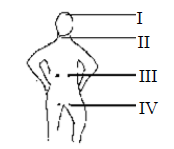
the position labelled I is the
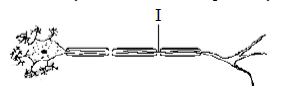
in the
parasympathetic nervous systems
central nervous system
nervous system only
only
The point marked I is
referred to as
1. D
6. C
11. C
16. C
2. C
7. C
12. D
17. C
3. A
8. C
13. C
18. D
4. A
9. B
14. D
19. B
5. A
10. B
15. D
20. C
THEORY
(SSCE, 1993 Q1) (b) With the aid of a
labeled diagram describe the structure of a motor neuron of a mammal.
Solution
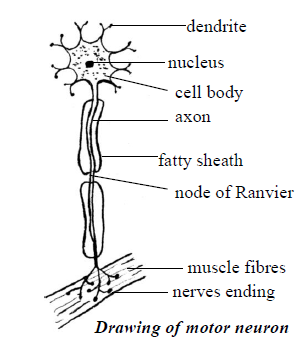
the Axon. The cell body has a large nucleus embedded in dense cytoplasm
containing Nissl granules. Extending from it are dendrons which branch into
dendrites. An extended part (axon) transmits nerve impulses. Surrounding and
insulting the axon is a fatty sheath covered by the neuilemma. The myelin
sheath is not continuous but has gaps in it called the nodes of Ranvier. The
terminal region of the axon is broken up into many fine branches with swollen
end plates, which communicates with adjacent neurons through synapse
(SSCE 1995) (a) Describe the structure of the mammalian eye, indicating the
functions of various part.
Describe one type of eye defect and how it can be corrected.
(SSCE 1999 Q7) (a) Explain the term voluntary action
reflex arc
reflex arc function?
How does the human ear functions as a hearing organ?
the body initiated under the direct control of the brain and can therefore be
suppressed. E.g. walking, speaking writing.
during reflex action. The reflex arc has five basic components: sensory
receptor, sensory neuron, an interneuron, motor neuron and an effector organ.
transmitted by sensory neuron from the receptor to the spinal cord through the
dorsal root. The intermediate neuron receives impulses from the sensory neuron
and passes them to the motor neuron. The motor neuron then sends impulses out
of the spinal cord via the ventral root to an effector organ (muscle or gland)
where a quick response is produced. All the neurons are linked by synapses
across which impulses are sent.
2001 Q6) (a) (i) describe the structure of the following parts of the
mammalian eye:
layer
functions of the parts of the mammalian eye listed in (i) above.
sight?
sightedness?
sightedness corrected
(SSCE 2003 Q4) (a) Explain the term co-ordination in mammals
of mammals
structure of a motor neuron of a mammal.
(WASSCE 2007 Q1) (a) Describe the structure of the mammalian ear
responsible for
mechanism by which the ear helps to maintain balance in mammals
Hearing:
cochlea
(c) Refer to blog content
6. (WASSCE 2009) (a)(i). make a large diagram 10-12cm long of a vertical section of the
mammalian eye and label it fully
(ii) State one function
each of five of the labelled parts
(b)(i)
Describe the eye defect of short sightedness (ii) State how the defect can be
corrected
Solution
Refer to blog content
7. (WASSCE 2013 Q1) (a)(i) What is endocrine glands?
(i) Name three endocrine glands that are associated
with reproduction in human males.
(ii) . name one hormone produced by each of the
glands named in (a)(ii) above.
(iii) State two general characteristics of hormones
(b) (i) What is the autonomic nervous system
(ANS)?
(ii) Name the two types of nerves that form the
ANS
(b) State (i) the type of action that are
controlled by ANS;
(ii)
three examples of such actions.
Solution
Refer to blog content
Click Here for WAEC /SSCE/ WSSCE/ NOVDEC Biology Past Questions and Answers