SSCE/WASSCE/GCE PASS QUESTIONS AND ANSWERS ON SOIL
OBJECTIVES / MULTIPLE CHOICES
5 g of oven dried soil was
heated in a furnace for 24 hours. After cooling, it weighed 4.8 g. What is the
amount of humus in the soil?
2.
Most irrigated lands often
become unproductive in later years because of
Farmers practice crop rotation because it
the same time
cultivation
Fertilizers are lost from
the soil through
and run-off
wind erosion
Soil with the finest
particles is called
Soil fertility can be
conserved and renewed by
debris
In a soil sample, the
relative amounts of the different soil particles can best be determined by the
process of
Soil micro-organisms are
beneficial because of their involvement in
using a measuring cylinder, it was found that:
initial volume of water …. = p cm3volume of soil before mixing with water = q cm3initial volume of water …. = p cm3volume of soil before mixing with water = q cm3initial volume of water …. = p cm3volume of soil before mixing with water = q cm3
soil = r cm3. From the data above, which of the following deductions
is correct?
fertility?
is one that is
crops
available for plants is
is then heated in an oven at 100°c for 1 hour. After cooling in a desiccator,
the weight was 8 gm. The percentage of water in the soil is
sample, the following readings were recorded:
cm3
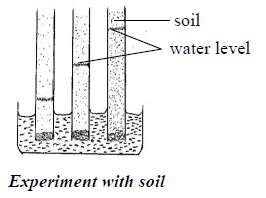
The figure above represents
an experiment with three types of soil. The experiment demonstrates
1. C
6. B
11. D
16. B
2. A
7. D
12. B
17. B
3. C
8. C
13. B
18. D
4. B
9. A
14. D
19. A
5. B
10. D
15. A
20. C
THEORY
1.
Discuss
(a) five ways in
which soil may lose its fertility
(b) five ways in
which soil fertility may be maintained or renewed.
Solution
Refer to the blog content
2.
(SSCE, 1997) (a) What is meant by soil?
(b) Explain why
loam is a fertile soil
(c) What are the
effects of
(i) adding animal
manure to the soil?
(ii) adding lime
to the soil?
Solution
(a) Refer to the blog content
(b) Fertile soil provides adequate conditions for plant growth. Loam
is fertile because it comprised of a mixture of clay, sand and silt with a
suitable proportion of humus. The mixture of these particles of different of
sizes, ensures adequate nutrients are available to plants. The proportions of these particles also allow
the soil to combine the necessary water-holding properties without reducing
aeration, and also prevent water logging. The humus or remains of dead organism
acts as a base of a decay chain.
(c) (i) The manure provides nitrogenous materials which is converted
to ammonium compounds and are acted upon by nitrifying bacteria. The manure
improves the water holding capacity of the soil.
(ii) Lime is added to the soil to reduce alter its pH. It also aids
the clay particles to clump together into large crumbs, which have larger air
spaces between them and provides better drainage and aeration.
3.
(WASSCE 2007 Q6) (a) List four soil
constituents.
(b) State four
characteristics of fertile soil.
(c) Describe four
ways in which soil fertility can be maintained.
Solution
(a)
Organic matter (humus), living
organism, minerals salt, air, water, soil particles
(b)
& (c) Refer to the blog content
4.
(WASSCE 2014 Q3) (d) State six methods of
conserving soil.
Solution
Refer to the blog content
Click Here for WAEC Past Questions and Answers