
SSCE/WASSCE/GCE PAST QUESTIONS
AND ANSWERS
OBJECTIVES
following bones make up the axial skeleton except the
attached to bones by means of
vertebrae lacks a centrum?
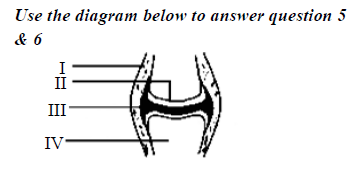
The part labelled III is
the
labelled I is to
joint
joint
the correct order of the vertebrae along the spinal column?
cervical → sacral
lumbar→ sacral
lumbar → sacral
sacral → lumbar
arm, the biceps muscles
relaxes
contracts
A band of connectivity
tissue linking two bones in a joint is known as
is composed of the pectoral girdle
Which of the following is
not a function of the mammalian skeleton?
hydrostatic skeleton is
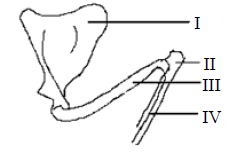
Which of the bones is the
radius?
A. I B. II C. III D. IV
15. The scapula and the ischium
are part of the
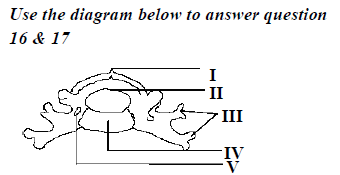
The structure above represents
through the structure labelled
The presence of
endoskeleton is characteristic of
exoskeleton is the type of
supporting system found in
A unique characteristic of
the cervical vertebrate is the presence of
|
1. D |
6. C |
11. C |
16. D |
|
2. C |
7. C |
12. D |
17. C |
|
3. A |
8. A |
13. B |
18. B |
|
4. C |
9. D |
14. D |
19. D |
|
5. C |
10. A |
15. B |
20. D |
THEORY
1.
(SSCE 1996) What is a skeleton?
(b) Name the main
types of skeletons found in animals and for each type, give one example of
animal in which it is found.
(c) What are the
functions of the mammalian skeletons?
(d) Using a suitable
example, discuss the role of skeletal joint in movement in mammals.
Solution
a) Refer to blog content
(d) Role of skeletal joint in movement
The role of skeleton joint in movement is to
permit free movement without injury to the bones. Where two or more bones meet,
there is a joint, with the bones held loosely together by muscles and ligaments.
Articulating surfaces of the bones are covered with cartilage to prevent
wearing of the bones. There is the synovial membrane in between the bones which
secretes the synovial fluid which acts as a lubricant. Before movements occur
in the forearm, there must be two muscles that are antagonistic and must have
point of origin to an immovable bone and point of insertion to a movable bone.
The forelimb has its biceps originating from the scapula and point of insertion
on the radius. The triceps has its origin at the scapula and the head of the
humerus and its point of insertion on the ulna. The arm is straightened when
the triceps contracts and the biceps relaxes. When the biceps contracts and the
triceps relaxes the lower arm is raised.
(SSCE, 2000) (a) (i) Describe the girdles found mammalian skeleton.
girdles with limbs.
joint in one of the girdles you have named in (ii) above.
girdles in the mammal skeleton brings about movements.
(a) (i) Two girdles are the pectoral and pelvic
Refer to blog content
(ii) The two girdles form a ball and socket
joint with the fore and hind limbs.
(iii) Ball and socket joint between femur and
pelvic girdle or between humerus and pectoral girdles. The joint has surfaces
covered with articular cartilage to prevent wearing off of the bones. The
cartilage is flexible and acts as a cushion to absorb frictional forces when
bones touch and rub. The two bones with the joint are separated by synovial
membrane which enclose a synovial cavity and it secrets synovial fluid to
lubricate the joint. There is capsular ligament that join bone to bone. The
head of the limb bone such as femur and humerus fits into the socket of the
girdle i.e. femur into the acetabulum and humerus into glenoid cavity.
(b) Movement of the pectoral girdle:
the biceps (flexor and triceps (extensor) are antagonistic muscles, with both
having their point of origin on the scapular and their point of insertion on
the ulna and radius. When the bicep contracts, the lower arm is raised and when
the triceps contracts the lower arm is straightened.
Movement of pelvic girdle: the two muscles involved are the extensor and
flexor. Both have their points of origin on the pelvic girdle end point of
insertion on the tibia and fibula. Contraction of the extensor muscles
straightens the knee joint and legs moves backwards.
Click Here for WAEC/ SSCE/ WASSSE/ NOVDE Biology Past Questions and Answers