SSCE/WASSCE/GCE PASS QUESTIONS
AND ANSWERS
OBJECTIVE
Use the following phyla to answer question 1 and 2
Amoeba belongs to the
phylum
I
Which of the following
pairs of phyla are closely related?
I and II
I and III
found in rhizopus is
fragmentation
binary
Antheridium produces
gemmae
ova
between the bread and the blackish growth referred to
Saprophytism
symbiosis
Spirogyra reproduces
sexually by
copulation
fragmentation
conjugation
The locomotory structure in
paramecium is
cilium
cytoplasm
differentiates Amoeba from other unicellular organisms? Presence of
chloroplast
nuclei
as animal because it possesses
flagellum
pyrenoid
Ascomycota
Basidiomycota
it sensitive to temperature
it can manufacture its own food
reproduction
it bears spores contain in
sporangia
Paramecium
Amoeba
in a typical plant cell?
Contractile vacuole
Flagellum
Damp soils
Muddy ponds
Plasmagel
Pseudopodium
Euglena
Rhizopus
Rhizopus?
Respiration
Photosynthesis
food is absorbed through the
mycelia
fungi grow on dead organic
matter
fungi lack chlorophyll
fungi may assist in the decay
of food
antherozoids
germma
1. A
6.D
11. D
16. C
2. B
7.A
12. B
17. D
3.D
8. D
13. C
18. B
4.C
9.A
14. D
19. C
5.A
10.D
15. D
20. C
THEORY
1.
(SSCE, 1993 Q2) (b) Describe the life of
a moss plant.
2. (SSCE, 1994) (a) List any three feature that make euglena an animal.
Solution
of euglena.
animal-like features of euglena.
are not exposed to the environment.
(WASSCE, 2006 Q5) Outline the life cycle
of a named bryophytes
process of osmoregulation in Amoeba.
osmosis. The contractile vacuole removes the water which diffuses into the
organism. It then contracts expelling the liquid in it into the surrounding
water. This process regulates the amount of water present in the cytoplasm.
(WASSCE, 2008 Q5) (a) Describe the life
cycle of fern.
the sporophytes and the gametophyte. The sporophyte is dominant and diploid and
produces spores in sporangia borne on the leaves. The spores are haploid. The
spores germinate into prothallus, which constitutes the gametophytes. The
gametophytes are an independent haploid plant, and bears both male and female
sex organs i.e., antheridia and archegonia. The antheridium produces many
antherozoids which are flagellated. The archegonium produces only one oosphere
(egg). The antherozoids swim and enter archegonium. It fuses with the egg to
form a zygote, which remains in archegonium and develops into a new sporophyte.
The sporophyte initially depends on the prothallus for nourishment.
(WASSCE, 2014) (i) Name one organism
that exhibits both plant and animal features
organism named in (c) (i) above.
Chlamydomonas
(WASSCE,
2014) State two reasons why bryophytes are confined to damp habitat.
(ii) Named three
organisms that reproduced conjugation
Solution
Sexual reproduction of
bryophytes requires water or moisture through which the male gamete swims to
the female gamete.
They do not have true roots to
absorb minerals and water and therefore, absorb water all over their body
surface by simple diffusion and osmosis.
The plant surface lacks a
cuticle which enables it to absorb water through its surface.
They are non-vascular; hence
they have direct contact with water.
(ii) Organisms reproduce by conjugation
Paramecium, Zygonema, Chlamydomonas, spirogyra, Rhizopus/mucor
SSCE/WASSCE/GCE PASS QUESTIONS
AND ANSWERS
OBJECTIVEs / MULTIPLE CHOICES
1. One of the following
arrangements is correct about stages of development in insects.
Egg……..larva…….pupa………adult
Egg…….pupa……..larva………adult
Egg…….adult……..pupa………larva
Egg…….pupa……..adult………larva
cockroach completely covered by wings at rest are the
sterna
pleura
A characteristic feature of
insects which jump is the possession of
membranous hind wings
stout and powerful hind limb
additional anal appendages
long slender hind limbs
The caterpillar is attached to
the silk pad by
true legs
prolegs
In weevils, the scape is found
at the end of the
rostrum
walking
possesses an exoskeleton made of nitrogenous polysaccharide called
antennae
maxillary palp
The following are social
insects except
wasps
termites
A life cycle consisting of a
developmental transformation of forms which take place between larval and adult
forms of arthropods and amphibians is called
Which of the following
developmental stages is not present in complete metamorphosis?
imago
larva
Members of the Diptera possess
Soft bodies, biting mouthparts
and two pairs of membranous wings
Halters, piercing mouthparts
and a pair of membranous wings
mouthparts and vein wings
leathery wings
The following activities are
behavioral characteristic of termites except
Aestivation
Burrowing
Searching for food
Honey bee worker carries out
one the following functions except
laying of eggs
building nest
the vector of malaria parasites
is the
male anopheles
female culex
What is the significance of bee
dance to other bees?
Warning signal
mating signal by male
Presence of food
time for nuptial flight
In which of the following organism
belong to order lepidoptera?
Which of the following insects
undergoes incomplete metamorphosis?
The excretory organ in insects
is the
The butterfly is of great
economic importance because
scientific studies
from flowers
beauty of the environment
of crops and other plants
Which of the following insects
lays its eggs in horny, purse-like cases?
The group of insects that
undergoes complete metamorphosis is
beetles and cockroaches
grasshoppers and bees
beetles and butterflies
and butterflies
The ability of the cockroach to
live in cracks and crevices is enhanced by the possession of
segmented body
flattened body
The caste of termites that
lacks pigmentation is the
In the honey bee colony, the
drones are
parts
mouth parts
parts
parts
The group of insects that have
mouth parts adapted for both piercing and sucking is
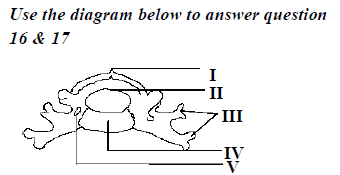
The structure labelled II is
used for
The structure labelled III
represents the
The jointed structure in
insects that bears organs which are sensitive to touch, smell and vibration is
the
A feature of the caste system
of bees and termites is that
An insect whose economic
importance is both harmful and beneficial is the
An insect with a mandibulate
mouth part will obtain its food by
Answers
|
1. A |
7. C |
13. D |
19. D |
25. B |
|
2. D |
8. C |
14. C |
20. C |
26. C |
|
3. D |
9. C |
15. A |
21. D |
27. C |
|
4. D |
10. B |
16. B |
22. B |
28. A |
|
5. C |
11. A |
17. B |
23. C |
29. D |
|
6. C |
12. A |
18. D |
24. C |
30. A |
THEORY
1. (SSCE, 1993 Q1) (b) Describe the life
cycle of
(i)
Cockroach
Solution
(i) The life cycle of cockroach shows an incomplete metamorphosis.
During mating the male produced sperms and discharged them into the female through
the genital pore. The sperms are stored in the sperm pouch of the
female. The sperms fertilize the eggs inside the female (internal fertilization).
The fertilized are enclosed in an egg case called ootheca. The female carries the ootheca in her genital pouch for some time
and later deposited in a dark, warm place or in cracks. After six weeks, the
eggs hatch into young, colorless, and wingless cockroaches called Nymphs. The
nymphs feed and develop into the adult.
2.
(SSCE, 1993 Q5) (a) Describe the caste system
in termites.
(b)
Discuss the economic importance of the following insects:
(i)
Weevils
(ii) Cotton Stainer
(c)
How can weevils be controlled.
Solution
(a) & (b) Refer to blog content
3.
(SSCE 1998 Q6) Consider the following
insects:
(i)
termites
(ii) cotton strainers
(a)
Give the economic importance of each of them.
(ii)
Explain two control measures used
against each of them.
Solution
Refer to blog content
4. (SSCE, 2000) Explain briefly the
following terms:
(i)
ecdysis
(ii)
complete metamorphosis
(iii) incomplete metamorphosis
(b)
(i) What are the essential features of stages of the cycle of an insect with
complete metamorphosis
(ii)
Explain briefly how the life cycle in complete metamorphosis differs from that
of incomplete metamorphosis.
(iii)
indicate the stages in life cycle of the butterfly which are of economic importance,
giving one reason for each stage.
Solution
(i) Ecdysis is the periodic shedding of the exoskeleton of
an arthropod to enable growth to take place.
(ii) & (iii) Refer to blog content
(b) (i) it involves definite developmental stages such as eggs, larva,
pupa and imago (adult). The eggs contain the fertilized ovum which develops
into the larva. The larva is an active feeding and growing stage. The pupa is
outstandingly inactive but with a lot of reorganization taking place
internally, which leads to the formation of adult structures inside. The adult
is sexually matured organism and dispersal stages are distinctive in all
aspects such as morphology, physiology and in behaviors.
(ii) The stages after hatching are distinct in complete
metamorphosis, but similar except in size in incomplete metamorphosis. Changes
in development stages are fast in complete metamorphosis but gradual in
incomplete metamorphosis. The young individuals and adults have different diets
in complete metamorphosis but the diet is similar in complete metamorphosis.
The dominant stage in complete metamorphosis is the pupal stage, which is
absent in incomplete metamorphosis. Adult and young differ in habitat in
complete metamorphosis but in incomplete metamorphosis the habitat is the same.
Young and adult differ in behavior in complete metamorphosis, however, behavior
is the same in incomplete metamorphosis.
(iii) The larva stage feed on leaves i.e., it defoliates plants. The
adults also pollinate flowers, thereby in some cases destroy the citrus as they
suck the nectar.
5.
(SSCE, 2002 Q3) Describe the
(a)
external features of the different members of the termite colony
(b) mode of life of termites
Solution
(a) Refer to blog content
(b) Mode of life of termites
Termites are social insects. They live together in a colony where
there is division of labor. A colony consists workers, soldiers, and winged reproductive.
Workers are completely blind, wingless, and sexually immature. They feed other
members, dig tunnels, locate food and build and repair the nest.
Soldier termites defend the colony against invaders.
Reproductives are the sexual forms of a colony. They go on nuptial
flight, and become the king or queen termites of their newly-established colony.
The queen duty is to lay eggs and king fertilizes the eggs
6.
(SSCE, 2004 Q2) (a) State the type of
life cycle exhibited by each of the following organisms:
(i)
Termite (ii) Butterfly (iii) Moss
(b)
(i) Describe the mode of life of termites
(ii)
State five ways in which termites are of economic importance.
Solution
(a) (i) incomplete metamorphosis(ii) Complete metamorphosis
(iii) Alternation of generation
(b) Refer to blog content
7. (SSCE, 2008) (a) List three external
features common to all arthropods.
(ii) List three characteristics features of
insects
(b)
(i) Describe the structure of soldier termite.
(ii)
State one function of each of the members of the various termite castes.
(c)
(i) What are social insects?
(ii)
State three common features of social insects.
Solution
(a) (i) External features of arthropods
· Segmented body
(ii) Characteristics features of insects
1. Three body division (head,
thorax and abdomen)
2. Thorax made up of prothorax,
mesothorax and metathorax
3. Three pairs of legs
4. Pair antennae
5. Most with wings
(b) (i) & (c) Refer to blog content
8.
(WASSCE 2014) (i) State two beneficial and one
harmful effect of bees to humans
Solution
(i) Beneficial effects of bees
1. Production of honey
2. Production of wax
3. Agent of pollination (in crop
production)
(ii) Harmful effects of bees
1. Stings humans (leading to death)
2. Constitutes nuisance/invade
houses/ communities
SSCE/WASSCE/GCE PASS QUESTIONS
AND ANSWERS
OBJECTIVES / MULTIPLE CHOICES
1.
Which of the following
external features found only in lizards?
A.
nostril C. tail
B.
scaly skin D. nuchal crest
2.
Which of the following
characteristics show that reptiles are more advanced than amphibians?
A.
Possession of pigment skinB.
Laying shelled eggsC.
Possession of homodont teethD.
Possession of vertebral column
3.
The excretion of uric acid
is an adaptation for conservation of
A.
energy C. heat
B.
salt D. water
4.
The main nutrition
exhibited by lizard is
A.
insectivorous C. commensalism
B.
omnivorous D. herbivore
5.
Which of the following fins
provides the major force which drives a fish forward?
A.
caudal fin C. ventral
B.
pectoral fin D. pelvic
6.
The following are all
functions of the jelly surrounding the egg of a toad except
A.
provide food for the embryo
B.
prevents overcrowding
C.
enable eggs to float
D.
protects eggs from infection
7.
The membrane that protects
the outer surface of the eye ball of a bird
A.
tympanic
B.
plasma membrane
C.
nuclear membrane
D.
nictitating membrane
8.
Fishes cannot survive on
land because it has
A.
a streamlined body C. no lungsB.
scales D. no external ear
9.
Which of the following is
not true about lateral line in Tilapia?
A.
It runs down side of the bodyB.
It aids swimming movementC.
It opens to the water via tiny
holeD.
It contains cells which pick up
vibrations
10. All the following aid flight in birds except
A.
Down feathers C. Hollow bonesB.
Streamline shape D. Quill feathers
11. The toad makes use of the following parts for respiration when on
land
A.
Mouth and lungs C. Skin and lungsB.
Lungs and nostril D. Mouth and skin
12. One of the following is a paired fin in a bony fish
A.
Pelvic fin C. Caudal fin
B.
Dorsal fin D. Ventral fin
13. The significance of croaking in toad is to
A.
Attack is enemies
B.
Attract the female for mating
C.
Make use of poisonous glands
D.
Feed on insects
14. All the following are the similarities between the Tilapia and
Tadpole except
A.
Both have streamline body shape
B.
Both possess tails
C.
Both possess gills for
respiration
D.
Both have lateral lines
15. All the following are associated with the movement of Tilapia except
A.
Rolling C. Pitching
B.
Yawing D. Tenting
16. Which of the following organism is considered as the most evolutionary
advanced?
A.
Toad C. LizardB.
Domestic fowl D. Cheetah
17. One of the following is not a feature of reptiles
A.
Possess dry skin covered with
scalesB.
Possess two pairs of limbs
which ends in clawed digitC.
Dentition is homodontD.
Lay unshelled eggs that
fertilized externally in water
18. A flying bird is able to move through the air with least frictional
resistance because of its
A.
feathers C. streamlined shapeB.
small head D.
wings
19. Cold-blooded vertebrates that spend part of their life cycle in
water and part in on land but return to water to reproduce belong to class
A.
Reptilian C. AmphibiaB.
Mammalia D. Pisces
20. A feature which adapts birds to flight is the possession of
A. scaly legs C. two walking legs
B. light bones D. a pointed beak
21. The gill rakers of fishes take part in
A. respiration C. swimming
B. feeding D. diffusion
22. Gaseous exchange in Aves occurs in the
A. tracheoles C. air sacs
B. bronchi D. trachea
23. The bright colours of the comb and feathers in the peacock are for
A. sex differentiation C. courtship
B. beauty D. defense
24. Which of the following vertebrates does the skin function as a
respiratory surface?
A. Rat C. Fish
B. Lizard D. Frog
25. Cutaneous respiration is carried out by
A. Birds
C. Snakes
B. Frog
D. Fishes
26. Scales on reptiles are a feature for
A. conserving water
B. conserving food
C. protecting the skin
D. locomotion
27. The colour of the ventral surface of a fish is lighter than that of
the dorsal. This is mainly
A. an adaptation for movement
B. an adaptation for camouflage
C. for attracting mates
D. for regulating body temperature
28. The structure that prevents food particle from escaping through the
fish gills are called gill
A. arches C. rakers
B. filaments D. lamellae
29. The possession of scales, laying of eggs with shells and bony
structure of the head are characteristics shared by
A. birds and reptiles
B. fishes and birds
C. reptiles and fishes
D. birds and mollusks
30. In a group of male Agama lizards, the one with the brightest head
colour is the
A. dominant C. oldest
B. youngest D. largest
Answers
|
1. D |
7. D |
13. B |
19. C |
25. B |
|
2. B |
8. C |
14. D |
20. B |
26. C |
|
3. D |
9. B |
15. D |
21. B |
27. B |
|
4. A |
10. A |
16. C |
22. C |
28. C |
|
5. A |
11. A |
17. D |
23. C |
29. A |
|
6. A |
12. A |
18. C |
24. D |
30. A |
THEORY
1.
(SSCE, 1994 Q2) (i) In which way is
fertilization in a toad different from that in mammals
(ii) List the advantages of fertilization
found in mammals.
Solution
(i)
Fertilization in toads is
external while that of mammal is internal.
(ii) Advantages on internal fertilization
v The mother’s circulation system removes excretory products of the
embryo.
v Embryo obtains oxygen and nutrients from the mother.
v The embryo is protected from shock by the amniotic fluid
v There is high probability of fertilization.
v The embryo is free from external dangers.
2.
(SSCE, 1996 Q4) Discuss the gaseous
exchange in
(i)
Osteichthyes (ii) Amphibian
Solution
Gaseous exchange in Osteichthyes
During gaseous exchange, the mouth opens to take in water containing
dissolved oxygen, whiles the operculum is pressed to the head. The mouth is
then closed. The floor of the buccal cavity and pharynx are raised and the
opercula are open as water is forced over the gills. As water flow past the
gill filaments, oxygen diffuses into the blood and carbon dioxide diffuses out.
Gaseous exchange in Amphibians
When at rest on land, amphibians take in large volume of air into
the mouth and uses the floor of the buccal cavity to press the air against the
lining of the mouth. Gaseous exchange occurs through the mucus lining of the
buccal cavity. This is called buccal respiration.
In water, exchange of oxygen and carbon dioxide take place between
the water and capillaries of the skin by diffusion. This is referred to as cutaneous
respiration.
When active amphibians use the lung in respiration. The mouth is
closed and the floor of the buccal cavity is lowered. The toad draws air in
through its nostrils and pumps it into the lungs by raising the floor of the
mouth. Gaseous exchange takes place in the lungs. This type, is describe as
pulmonary respiration.
3.
(SSCE, 2001 Q4) (a) (i) State five
characteristic features of reptiles
(ii) State three structural features that
distinguish amphibians from reptiles.
(b) How are the limbs of a
toad adapted for movement?
(c) (i) State the various
ways by which gaseous exchange takes place in toad
(ii) Give two features common
to the structures used during gaseous exchange.
Solution
(a)
(i) ●
presence of homodont dentition
·
Body covered with scales
·
Lay soft-shelled eggs
·
Absence of external ear
·
Limbs have clawed digits
·
Presence of two pairs of limbs
(ii) Hind limb digits are webbed, skin is moist, and jaws do not contain
teeth.
(b)
Hind limbs are webbed providing
large surface area to push against water when swimming. They are longer and more
muscular to lift the body off ground when hopping and are used for crawling on
land. Forelimbs are short and stout to keep the front part of the body raised
above the ground when at rest, and to absorb the shock of land after hopping.
(c)
(i) ●
buccal (mouth) respiration
·
Pulmonary (lung) respiration
·
Cutaneous(skin) respiration
(ii)
¨
Large surface area,
¨
moist surface,
¨
thin surface area and highly
vascularized
4.
(SSCE, 2005 Q4) (a) With the aid of a
labeled diagram 8-10 cm long, describe the external features of tilapia
(b)
How does Tilapia get rid of its excretory products?
Solution
(a) External features of tilapia
Tilapia has a streamlined body shape, covered with flattened,
discoid overlapping scales. The
mouth is terminal with a pair of nostrils above. It has operculum at each side
of the head. The lateral line is present each side of the fish, that runs along
behind the head to the tail. There are three single or unpaired fins. These are the dorsal fin, the anal fin and the
caudal or tail fin. The paired fins are the pectoral fins and the pelvic fins.
(b) Nitrogenous waste
substances, excess salts and water are excreted by the kidney in urine. Carbon
dioxide is excreted by diffusion out of the body through the gills.
5.
(SSCE, 2009 Q5) (a)(i) What are
amphibians?
(i) Give two examples of amphibian
(b) Explain why a named amphibian is
considered successful in its mode of
(i) Respiration
(ii) Reproduction
(c) (i) List two external features of
birds (ii) State how the features named in (c) (i) above adapts the bird to
flight.
Solution
(a) Amphibians: these are cold-blooded animals which spend part of
their life in water and on land.
(ii) Toad, frog, salamanders, newts
(b) Frog:
Respiration in a named amphibian
At larval stage tadpoles, possess vascularized gills for gaseous
exchange in water. At adult stage, the moist thin skin allows dissolved oxygen
to diffuse into the capillaries when in water, while on land the atmospheric
oxygen diffuse into the vascularized lungs to the surroundings. Also in the
buccal cavity, gaseous exchange occurs through the blood capillaries lining the
floor of the buccal cavity. The position of the nostril above the mouth,
enables the passage of atmospheric air into the body while swimming.
(ii) Reproduction in a named amphibian
The male mounts on the back of a female, gripping her under the arms
with his forelegs. When she lays the eggs the male releases sperms to fertilize
them. This ensures external fertilization and prevent wastage of sperms. The eggs
are surrounded by a layer of jelly, which protects the eggs from mechanical
injury, prevent drying up, protects the egg from bacterial infection, being
eaten by predators, enables the eggs to float on the water surface, prevent
overcrowding of eggs/allows room for development/better circulation of air.
(c) External feature of birds
v A pair of eyes
v Has streamlined body shape
v Presence of feathers
v Presence of beak
v A pair of well-developed wings
v A pair of scaled hind limbs
v Presence of digit with claws
v Presence of tail features
(ii) Features of adaptation of birds to flight
Refer to blog content
Click Here for WAEC Past Questions and Answers