SSCE/WASSCE/GCE PASS QUESTIONS
AND ANSWERS
OBJECTIVES
During cell division, the two
strands of chromosomes are joined at a point called
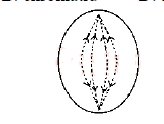
What stage during cell
division is represented in the figure above?
Telophase
During binary fission in
lower organisms, the nucleus is known to undergo
One of the ways which body
cells differ from gamete cells is in the
contain

cell illustrated above
poles
equitorial planes
spindle
of spindles
to be resting
to daughter-cell through the process of
Which of the following
statements about mitosis is false?
DNA replication occurs in a
cell during
At the end of mitosis, the
number of cells produced from a parent cell is
At which of the following
stages of mitosis do the two daughter chromosomes separate completely?
cells in mammals do not normally undergo cell division?
cornified layer
epithelium
of the cheek
represented in the diagram is known as the
ln which of the following
structures will cells undergoing meiosis be seen?
leaf
The process of cell
division by meiosis takes place only in
Separation of sister
chromatids during meiosis occurs in
Meiosis is important
because it
in successive generations
flowering plants
are genetically identical
organisms
Meiosis take place
Answers
|
1. C |
6. A |
11. A |
16. D |
|
2. C |
7. D |
12. D |
17. C |
|
3. A |
8. D |
13. C |
18. B |
|
4. D |
9. A |
14. A |
19. A |
|
5. D |
10. A |
15. A |
20. B |
(SSCE, 1994 Q2) (b) (i) Gives five features that distinguish between the two types of
cell division that occur in the mammalian body.
Solution
(i) Five differences between mitosis and
meiosisR
efer to
blog content
2.
(SSCE, 1997 Q2) (a) What do you
understand by each of the following terms (i) mitosis (ii) meiosis
(b) (i) State two processes which occur in
meiosis but not in mitosis.
(ii) Mention two ways in which meiosis is significant.
Solution
(i) Mitosis is the division of a cell to form two daughter cell
contains the same number of chromosomes as the mother cells. It occurs in body
or somatic.
(ii) Meiosis is a reduction division of a cell, which occurs within
reproductive organs. It gives four gametes or spores with each having half the
chromosome number of the parent.
(b) The
following process occur only in meiosis· Formation of chiasmata
·
Pairing of homologous
chromosome occurs in meiosis
·
There is separation of
chromatids in meiosis whereas chromosome separation occurs in mitosis.
·
Two nuclear division occurs but
only one occur in mitosis.
(ii) Refer to blog content
3. (SSCE, 1998 Q3) Outline the main events during meiotic division in organisms
(Diagrams are not required)
(b) How can meiosis bring
about variation in organisms?
Solution
Prophase I
1. The chromosomes condense and membrane disintegrate
2. The homologous chromosomes pair up forming bivalents.
3. Pairing of homologous chromosomes may cross-over at points called chiasmata. Crossing over result in exchange of
fragments.
Metaphase I
1. The bivalents line up along the cell equator and attach to spindle
fibres at the centromeres.
Anaphase I
1. The homologous chromosomes separate and move towards the opposite
pole of the cell.
Telophase I
1. The nuclear membrane reappears and the spindle fibres disappear.
2. The process of cytokinesis occurs, forming two haploid daughter cells.
Prophase II
1. The nucleoli and the nuclear envelope
disappear,
2. The centrioles move toward the
poles.
Metaphase II
1. The spindle fibres grow from
the centrioles and attach to the centromeres
2. The sister chromatids line up
along the cell equator
Anaphase II
1. The sister chromosomes move
towards the opposing poles.
Telophase II
1. Chromatids reach the opposite
poles of the cells.
2. The nuclear membrane and
nucleolus reappears.
3. Cleavage or cell wall forms
which eventually produces a total of four daughter cells, each cell having
haploid set of chromosomes.
(c) The separation of
each pair of alleles of homologous chromosomes during meiosis in the process of
gamete formation, and the subsequent recombination during fertilization is a
random that brings alleles from parents together in different combination.
Secondary, due to crossing over that occurs during meiosis, new combinations of
genes are formed in the gametes which can as well lead to variation.
4.
(SSCE, 1999 Q2) (a) Explain each of the
following terms
(b) chromosome number
(ii) chiasmata
(iii) telophase
(iv) reduction division
(v) chromosomal replication
(b) State the significance of each of the
terms listed in (a) above
Solution
(i) Chromosome number: is the total number of chromosomes in
a somatic cell. It is fixed for any particular species. Man has 46, tobacco
plant has 48
(ii) Chiasmata: point at which non-sister chromatids of homologous chromosomes cross-over or meet
and exchange genetic material.
(iii) Telophase: is one of the phases in cell division where
chromosomes reach the poles, nucleolus reappear and nuclear membrane form
around them.
(iv) Reduction division (meiosis):
is type cell division which produced daughter cells that have half the
chromosome number of the parent
(v) Chromosomal replication: this is the duplication of
chromosome during interpose, so that single chromatid at the end of telophase
reappear in the following prophase as pairs of chromatids.
Significance
(i) Chromosome number: It helps in sex determination of an
organism e.g., in bees the drones are diploid and worker are haploid. It
determines the characteristics of an individual species. Change in chromosome
number give rise to new species.
(ii) Chiasmata: this keeps homologous pairs together as well
as evolution potential due to genetic recombination.
(iii) Telophase: new nucleus is reconstituted which results in
gamete formation in meiosis and formation of somatic cells.
(iv) Reduction division (meiosis):
allows formation of gametes, brings about variation and evolutionary potential
and fixing of parental genotypes.
(v) Chromosomal replication: prevents continual reduction of
genetic material at each cell division.
5.
(SSCE, 2005 Q7) (a) In which organ does
meiosis occur in
(i) Mammals
(ii) Flowering plants
(b) Compare mitosis with meiosis in a
tubular form.
(c) What is the importance of meiosis and
mitosis in living organism?
Solution
(a) (i) Mammals:
testis and ovary
(ii) Flowering
plants: anther and ovary
(b) & (c) Refer to blog content